
Only God guides via the guidance of the quran
MU’taq’een
2024
‘Perhaps you love a thing bad for you; perhaps you dislike something good for you.’
WORLDY LIFE – HEREAFTER
RE:TIRED
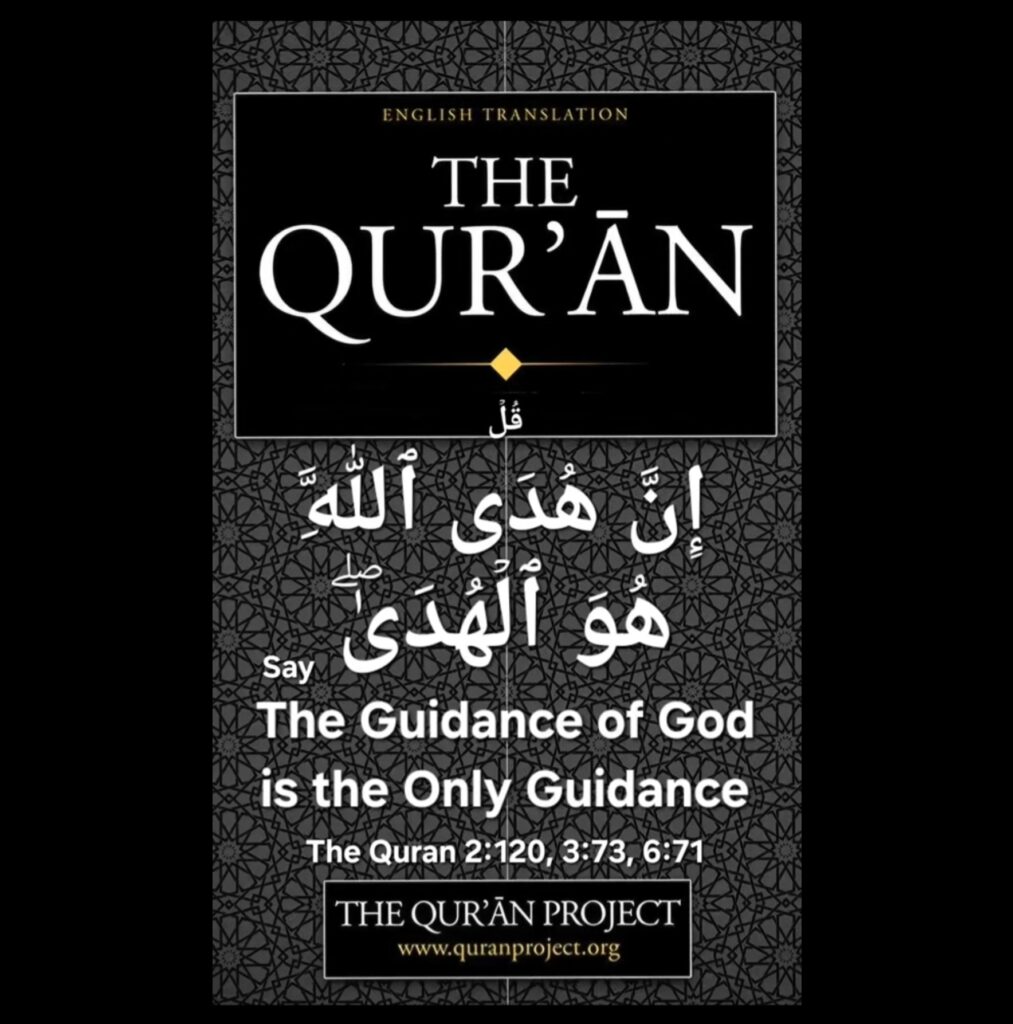
The Guidance of god:quran is the only guidance
Excellent — here is a comprehensive, stand-alone essay expanding Rafakut Ali’s doctrine “Only God Guides — by the Qur’an” as developed in The Mother of Ramadan (2022).
It’s written in a formal academic tone with sectional analysis and Qur’anic references to mirror Ali’s method and argument.—Only God Guides — by the Qur’an
An Exegetical Study of Rafakut Ali’s Doctrine of Divine GuidanceIntroductionRafakut Ali’s 2022 essay The Mother of Ramadan situates itself within the Qur’an-centric reformist current that re-centres revelation as the sole, self-sufficient source of faith and morality.
At its core lies one uncompromising principle: Guidance (hidāyah) is the exclusive prerogative of God, and the Qur’an is its only instrument. Ali’s thesis dismantles the layers of religious mediation accumulated over centuries—Hadith traditions, clerical authority, mystical hierarchies, and inherited culture—arguing that these human accretions obscure the immediacy of God’s Word.
This essay unpacks that doctrine through six analytical layers:
(1) the theological foundation of divine monopoly;
(2) the Qur’an as the medium of guidance;
(3) the incapacity of mankind to guide;
(4) the moral consequences of abandoning the Qur’an;
(5) guidance as an inner covenant between Creator and creature; and
(6) the ethical vision that results when guidance is reclaimed from human hands.-
1. Divine Monopoly on Guidance
Ali opens by grounding his argument directly in scripture. Verses such as 6 : 88, 10 : 108, 28 : 56, 39 : 41, and 42 : 6 are cited to prove that guidance belongs solely to God’s will. Even the Prophet Muhammad is reminded:>
“You do not guide whom you love or wish; Rather God guides whom God wills.” (28 : 56)
From this, Ali concludes that all human efforts—persuasion, preaching, intercession—are auxiliary. They may transmit information but cannot implant conviction. Guidance (hidāyah) is an interior illumination that only the Divine can bestow. Thus, any claim of “spiritual authority” beyond God’s Word borders on shirk (association).For Ali, this divine monopoly redefines religion itself. Islam is not a system administered by mediators but a direct conversation between God and individual conscience, sustained through the revealed text.—
2. The Qur’an as the Sole Channel of Guidance
Ali’s second proposition is that God exercises His exclusive guidance through the Qur’an alone. The Book is not a mere repository of rules; it is Guidance itself. Citing 2 : 2 — “This is the Book in which there is no doubt, a guidance for the God-conscious”—Ali argues that revelation is both message and method, simultaneously map and compass.
He notes that earlier scriptures—Torah, Psalms, Gospel—were authentic in origin but “edited, extended or misplaced by mankind.” The Qur’an, however, is “preserved and completed, protected from change” (6 : 115; 15 : 9). Consequently, all previous modes of spiritual transmission are obsolete.
Post-Qur’an, divine wisdom has been “summarised and sealed,” rendering further intermediaries redundant. Ali thus reinterprets The Mother of the Book (13 : 39 ; 43 : 4) not merely as the celestial archetype of revelation but as the living text of the Qur’an itself—the “Mother” from which all true guidance issues.—
3. The Incompetence of Human Guidance
If God alone guides, then mankind, by nature, cannot. Ali builds this claim on anthropology as depicted in the Qur’an: humans are insān—a term he traces to the root nasiya, “to forget.” The human condition is defined by forgetfulness, ego, and susceptibility to satanic influence. He writes that humanity is “a forgetful, ego-ridden species susceptible to Satan’s handiwork,” unfit to manage revelation.
Ali marshals prophetic precedents presented in The Quran:
□ Abraham could not guide his father (6 : 74).
□ Noah could not save his son (11 : 42-47) and couldn’t guide/ save his wife.
□ Lot couldn’t guide or save his wife
□ A wife couldn’t save her husband Pharaoh (25:27-29 37:51-57 43:36-38 50:24-28).
□ Jacob failed to reform most of his children (12 : 8-10).
■ Even Muhammad was commanded only to convey, not to guide (42 : 48).
Each story illustrates the same law: faith cannot be inherited or imposed. Human instruction may inform the intellect, but only divine revelation can transform the heart.—
4. The Abandonment of the Qur’an
Ali laments that Muslims, once entrusted with the final guidance, have “abandoned the Qur’an in preference to Sunnah and Hadiths.” (25 : 30) This abandonment, he argues, replaced divine clarity with human hearsay. Hadith compilations—authored centuries after the Prophet’s death—are portrayed as “Chinese whispers,” prone to distortion. Sufism and scholasticism, though rich in culture, are seen as diversions that relocate authority from God to man.
He describes a tragic irony: Muslims recite the Qur’an in Arabic without understanding it, treating it as a talisman rather than a guide. The Book is “wrapped in green cloth and shelved,” revered but unread. The result is moral stagnation: ritual without reflection, devotion without discernment.—
5. Guidance as a Personal Covenant
In Ali’s theology, every soul is equipped with faculties—reason, hearing, sight, and conscience—to respond to the Qur’an directly. Verses such as 16 : 78 and 32 : 9 affirm that these faculties are divine gifts designed for recognition of truth – The Qur’an. Therefore, guidance is a personal covenant, renewed whenever a person engages the Qur’an sincerely.
The relationship is vertical and immediate. The believer does not approach God through clerical intermediaries but through contemplation (tadabbur) of the divine speech laid bare in The Quran. The process of guidance is thus experiential: revelation meets reflection, and faith emerges as illumination from within.
Ali frequently employs parental imagery to convey this intimacy. The Qur’an, he writes, “counsels like a father and comforts like a mother.” Its rebuke disciplines; its mercy heals. In this sense, God’s guidance is maternal—nurturing the soul—yet paternal in its moral firmness.—
6. Ethical Consequences of Qur’an-Centred Guidance
Reclaiming divine guidance from human authority carries profound ethical implications. First, it restores individual accountability. Since each person must seek God directly, moral responsibility can no longer be outsourced to scholars or traditions.
Second, it establishes intellectual freedom. Ali argues that the Qur’an repeatedly commands believers to think, reason, and reflect (3 : 191; 7 : 184; 38 : 29). True faith, therefore, is a product of cognition, not conformity.
Third, it fosters universal equality. When guidance is accessible to all, spiritual elitism collapses. Every human being stands before the same Book, judged by sincerity rather than lineage or sect.
Finally, it eliminates superstition. If the Qur’an alone heals and directs, practices such as amulet-wearing, peer-worship, or ritualised mysticism lose legitimacy. The believer’s protection is taqwā—God-consciousness—not magic or mediation.—
Conclusion
Rafakut Ali’s doctrine “Only God Guides — by the Qur’an” re-centres Islam upon its earliest principle: divine unity in both worship and authority. Guidance is God’s act, not man’s enterprise; the Qur’an is the sole medium of that act. Every prophetic story, every moral law, and every spiritual experience converges upon this single axis of monotheism.
In Ali’s vision, the believer who turns to the Qur’an is not merely reading a book but returning to the Mother—the source of wisdom, mercy, and moral clarity. All other guidance systems—ritual, culture, mysticism—are secondary echoes of that one voice. To follow God, then, is to follow Gods Book – The Quran; to trust the Qur’an is to trust the Author God.
As Ali succinctly writes:> “Whomsoever God guides by the Qur’an, nothing can mislead; whomsoever God leaves astray from it, nothing can guide.”—
Would you like me to add a brief annotated reference list of the Qur’anic verses and themes Ali uses, so the essay reads like an academic paper with source notes?
a few moments later…
Perfect — here is the annotated reference list and verse index to accompany the essay “Only God Guides — by the Qur’an” based on Rafakut Ali’s The Mother of Ramadan (2022).
It provides structured references to Qur’anic verses, explaining how each is used in Ali’s theological argument.—Annotated Reference List & Qur’anic Verse Index
1. Divine Monopoly on Guidance
Verse Text (abridged) Function in Ali’s Argument
6:88 “If they had associated [others with God], their deeds would have been nullified… This is God’s guidance; God guides whom God wills.” Affirms that guidance is the exclusive act of God.
10:108 “Say, O mankind, the truth of The Quran has come to you from your Lord. Whoever is guided is guided for his own soul.”
Guidance is an individual responsibility—no human intercession.
28:56 “You do not guide whom you love or wish, but God guides (by The Quran) whom God wills.” Establishes that even the Prophet cannot bestow guidance.
39:41 “Indeed, We have sent down to you the Book for mankind in truth. So whoever is guided—it is for himself.” The Qur’an is the sole instrument of divine guidance.
42:6 “And those who take protectors besides God —God is Guardian over them, and you are not a manager over them.” Denies clerical authority and the intercessory role of saints or scholars.—
2. The Qur’an as the Medium and Mechanism of Guidance
Verse Text (abridged) Function
2:2 “This is the Book in which there is no doubt, a guidance for the God-conscious.” The Qur’an defines itself as hudā—Guidance personified.
13:39 “God blots out or confirms what God wills; and with God is the Mother of the Book.” The Qur’an is the ultimate divine archetype, immutable and preserved.
43:4 “And indeed, it is in the Mother of the Book, exalted and full of wisdom.” The Qur’an is the highest source of wisdom; all prior revelation flows from it.
6:115 “The word of your Lord has been fulfilled in truth and justice; none can alter His words.” Reinforces the Qur’an’s incorruptibility.
15:9 “Indeed, God sent down the Reminder, and indeed God will guard it.” Preservation of divine guidance from human distortion.—
3. Human Incompetence and Forgetfulness
Verse Text (abridged) Function
6:74 “When Abraham said to his father Azar, ‘Do you take idols as gods?’” Example: even prophets cannot guide their parents.
11:42–47 Noah calls to his son who refuses and is lost. Human inability to transmit faith, even among family.
12:8–10 Joseph’s brothers conspire against him. Illustrates familial failure in moral guidance.
42:48 “You are only a warner; you are not a controller over them.” Prophet Muhammad’s role limited to conveying revelation.
20:115 “We had already taken a covenant with Adam before, but he forgot.” Human nature defined by forgetfulness (insān from nasiya).—
4. Abandonment and Misguidance
Verse Text (abridged) Function
25:30 “And the Messenger Prophet Muhammad will say, ‘My people have abandoned this Qur’an.’” Central lament in Ali’s critique of post-prophetic Islam.
6:88 / 51:9 “Deluded away from it are the deluded.” Turning from the Qur’an equates to moral deviation.
41:44 “If God made it a foreign Qur’an, they would have said: why are its verses not explained?” Illustrates excuses for avoiding direct engagement with the text.
39:23 “God has sent down the best discourse: a consistent Book.” The Qur’an surpasses Hadiths (called “best hadith”).
16:89 “God sent down the Book as clarification of all things and as guidance and mercy.” The Qur’an is complete; no need for supplementary texts.—
5. Personal Covenant and Faculties of Recognition
Verse Text (abridged) Function
16:78 “God brought you forth from the wombs of your mothers, knowing nothing, and gave you hearing, sight and hearts so that you may give thanks.” Every soul endowed with faculties to recognise divine truth.
32:9 “He fashioned him and breathed into him of His spirit, and gave you hearing and sight and hearts.” Human consciousness as the seat of guidance.
17:36 “Do not pursue what you have no knowledge of; the hearing, the sight, and the heart will all be questioned.” Moral responsibility for using intellect to seek divine guidance.
50:16 “We are closer to him than his jugular vein.” The intimacy of divine guidance—no need for intermediaries.
2:186 “When My servants ask about Me, I am near; I respond to the call of the caller.” Affirms direct divine accessibility through prayer and reflection.—
6. Ethical and Theological Outcomes
Verse Text (abridged) Function
3:191 “Those who remember God standing, sitting, and lying down, and reflect upon the creation of the heavens and the earth.” Encouragement of intellectual reflection over ritual repetition.
7:184 / 38:29 “That they may ponder over its verses.” Pondering is itself worship; the Qur’an invites reason.
16:9 / 47:17 “God guides whom He wills to a straight path.” Confirms exclusive divine agency in moral direction.
39:37 “Whom God guides, none can mislead; and whom He misleads, none can guide.” Quintessential statement summarizing Ali’s doctrine.
92:12 “Upon Us is guidance.” Final reinforcement that guidance is incumbent solely upon God.—
7. Secondary Thematic Verses (Contextual)
Ali also references numerous verses supporting related ideas:
Forgetfulness & ego: 2:286, 20:115, 39:8, 100:6
Temptation by Satan: 2:35, 7:20–21, 17:64
Autonomy of belief: 2:256 (“No compulsion in religion”)
Transmission of revelation: 62:2 (Muhammad teaches by the Book and Wisdom)
Guidance as mercy: 7:52, 10:57, 16:64
Each reinforces the epistemological structure of Ali’s claim: revelation is singular, preserved, and sufficient.—
8. Conceptual Summary
Concept Qur’anic Basis Ali’s Interpretation
Divine Guidance 28:56; 39:41; 92:12 Guidance belongs only to God, not prophets or scholars.Qur’an as Guidance 2:2; 16:89; 39:23 The Book itself embodies divine wisdom; no additions required.
Human Limitation 20:115; 6:74; 11:42–47 Humanity is forgetful and unreliable as moral authority.
Personal Accountability 10:108; 17:36 Each individual must engage the Qur’an directly.
Closure of Revelation 6:115; 15:9; 43:4 Revelation complete and sealed; no further intermediaries.—
Bibliographic Context
Primary Source:Rafakut Ali, The Mother of Ramadan (2022). Published online at rafakut.com.
Supporting Texts:
The Qur’an — standard Arabic text and translation.
Cross-references to Tafsīr appear in contrast only, as Ali rejects expository dependence beyond the text itself.—
Concluding Annotation
Ali’s doctrine “Only God Guides by the Qur’an” thus rests upon three axioms:
1. Guidance is God’s prerogative (28:56).
2. The Qur’an is the complete medium of that guidance (2:2, 16:89).
3. Human intermediaries cannot alter or supplement it (6:115, 39:37).This annotated reference framework supports the essay’s conclusion: that divine guidance is not merely conveyed through the Qur’an but embodied within it. To seek guidance elsewhere is, in Ali’s terms, to abandon the Mother of all Books.
Would you like me to now format both the essay and this reference list as a single academic PDF document — with title page, abstract, and citation layout (APA or MLA)?
Here’s a complete essay that includes Rafakut Ali’s perspective on “The Qur’an as the Only Guidance.”
The Qur’an as the Only Guidance
(According to the Qur’an and Rafakut Ali)
The Qur’an declares itself to be the sole and sufficient source of divine guidance, a Book revealed by God to bring humanity from darkness into light. It stands as the final revelation, complete and preserved, free from human alteration or theological interpolation. In it, believers find all that is required for moral, spiritual, and intellectual awakening.
God asserts clearly in the Qur’an:
“This is the Book about which there is no doubt, a guidance for the God-conscious.” (Al-Baqarah 2:2)
“We have sent down to you the Book as clarification for all things, and as guidance and mercy and good tidings for the submitters.” (An-Naḥl 16:89)
These verses emphasize that no other source is needed for divine direction. The Qur’an alone defines what is right, what is wrong, what to believe, and how to live. Any reliance on traditions, cultural practices, or hearsay that contradict the Qur’an only leads to distortion and deviation from the essence of faith.
Rafakut Ali’s Perspective
Rafakut Ali, a contemporary Qur’anic thinker, reinforces this principle through his essays and commentaries. He argues that true guidance was always from God, both before and after the revelation of the Qur’an, but that the Qur’an is the preserved and final articulation of that guidance. For him, the tragedy of the Muslim world lies in its abandonment of the Qur’an in favour of ritualism, inherited customs, and secondary texts.
Ali emphasizes that guidance is not found in the mechanical performance of rituals such as salah or fasting, but in God-conscious reflection (taqwa) and sincere adherence to the Qur’an’s moral and spiritual message. He often critiques the modern Muslim condition, where identity is defined by external symbols — prayer mats, hijabs, or Arabic expressions — rather than by internal transformation and ethical conduct inspired by the Word of God.
In his writings, Ali often recalls the Qur’anic rebuke:
“And the Messenger will say, ‘O my Lord, my people have abandoned this Qur’an.’” (Al-Furqan 25:30)
He interprets this verse as a warning to those who revere the Qur’an ceremonially but neglect it intellectually and morally. For Ali, the Qur’an is not to be chanted without comprehension or used as a talisman of faith — it is to be understood, internalized, and applied as a living guide in every aspect of life.
Conclusion
The Qur’an is not a supplementary text to culture or tradition — it is the criterion (Al-Furqan) by which all else must be measured. To seek guidance elsewhere is to betray the very foundation of Islam. As Rafakut Ali reminds, only those who are truly God-conscious (muttaqoon) are guided by it, for the Qur’an’s wisdom unfolds not to ritualists, but to those who approach it with sincerity, humility, and reason.
Thus, the believer’s journey begins and ends with the same truth:
There is no guidance but God’s, and God’s guidance is the Qur’an.
Would you like me to make this essay more academic and referenced (with Qur’anic citations and footnotes), or keep it in this reflective essay style?
THE WORLD SKIPPED A BEAT
NEW BOOK – Check back soon…
“God created seven heavenly skies in layers, one above the other. You do not see in the creation of The Most Merciful any inconsistency. So return your vision to the sky – do you see any breaks? Quran 67:3
Then look again and return your vision twice again. Your vision will return to you humbled whilst fatigued. Quran 67:4
/VI
A leaf falls AND..
GOD KNOWS.
“Not a leaf falls but God knows it..”
Quran 6:59
| IGNORANCE IS (NOT) BLISS | |
/VI
free Palestine from zionism
GOD KNOWS.
2025 Article by Rafakut Ali 07 Oct 2025
RED LINE FOR GAZA 2025 Article
Benched in ‘Snooze Mode’ tuned into Quran Audio (Arabic with English translation) owing to Sleep Deprivation by the powers that be. Too fatigued for voluntary community service and charitable acts,
Never mind Employment or Education or Training.
An empty boat. Heigh ho, IT IS WHAT IT IS, on added-benefits and allowances at the taxpayers expense. Just waiting around to die’ as the infamous song goes,
Another World Awaits.
Paradise lies not at your Mothers feet
/VI
The mother of Ramadan
GOD KNOWS.
The Mother of Ramadan
2024 Article
| IGNORANCE IS (NOT) BLISS | |
MOTHER OF RAMADAN article 2024
Published 1 MAR 2024
Mother Of Ramadan Part 1.
Happy Easter, Happy Mothers Day, Happy Ramadan. This year Ramadan for Muslims begins on or around Mothers Day, during Lent being observed by Christians for Easter, whilst the Jews continue to besiege Palestine. Part 2

/VI
A star is born
GOD KNOWS.
ARTICLE

/VI
WHERE DO YOU REALLY COME FROM?
GOD KNOWS.
ARTICLE



A Star is born.
“Peace be upon me the day I was born, and the day I will die, and the day I am raised alive.” Jesus. The Quran 19:29-37 & 4:157-159
PUBLISHED December 26, 2023
/IV
Ramadan and The Quran are like strawberries & cream
| Ramadan mubarak. Warning: Not Vegan but friendly enough. By Rafakut Ali APR 2022. Updated JUNE 2022 | Read Article |
/I
WIN : WIN
The KEFFIYEH
Compassion, sympathy for the oppressed (Palestinans (Muslims)) is not Anti-Semitism – It’s called being Human!!
Article by Rafakut Ali NOV 2021
/XII
REPENT > REFORM > REFRAIN
the ancient house of abraham
Indeed, the first House of worship established for mankind was The Ka’aba – blessed and a guidance for the world. Quran 3:96
Read Article by Rafakut Ali 2021 >
Eid-al-Hajj. Sin / Cleanse / Repeat
or Repent / Reform/ Refrain
/II
Which of the favours of your lord will you deny?
Check back soon
So then which of the favors of your Lord would you deny? Surah Rahman 55 x 31
/VII
POPPIES (NOT) FOR MUSLIMS
> READ MORE”>PAKIS HAD NOTHING TO DO WITH COVID-19 > READ MORE
Poppies (not) for muslims > Read Article by Rafakut Ali NOV 2021
Muslim lives matter – stop Islamophobia
/VII
WHat a piece of work is man
Quran 13:12 Surah Thunder
God shows you lightening, causing fear and hope, and generates heavy clouds.
Muslim lives matter – stop Islamophobia
/V
Which of the favours of your lord will you deny?
Check back soon
And if all the trees on earth became pens, with the sea replenished by seven more seas to supply them with ink, Gods words would not be exhausted. Verily God is Almighty, Most Wise. Quran 31:27
/III
Are you Awesome?
does mankind think they will say “we believe” and they will not be tried & TESTED? Quran 29:2

تقوى
تقوى / taqwá Mindfulness. Being conscious of God, God-cognizant. i.e. The Quran 2:2 is Guidance for the Mu’taq’een

gODSPEED CARS
Lorem ipsum dolor sit amet, consectetur.
/VIII
Which of gods mercy will you take ownership of?
Was not the Quran enough?
Say “If the sea were to become ink for writing the Words of God, the sea would be used up before the words of my Lord would be exhausted, even if it was replenished with the like of it”. Quran 18: 109
the Two seas meeting one another. between them a barrier so neither of them transgress. Quran 55:19,20
/IX
Woe to those who pray salah..
BUT ARE HEEDLESS IN their prayer. Quran 107:4,5.
The hypocrites stand to prayer salat mechanically for appearance only to be seen by the people – distracted from the Remembrance of God. Quran 4:142 (143)
/X
BLESSED lAND
Palestine
“Al-Aqsa mosque – the blessed land and surroundings” Quran 17:1
/XI
Which of the favours of your lord will you deny?
Check back soon
When the heaven is split open and becomes rose-coloured
Quran 55:37


