re:tired
Unnamed prophets in the quran
MU’taq’een
2027
‘Perhaps you love a thing bad for you; perhaps you dislike something good for you.’
WORLDY LIFE – HEREAFTER
another World Awaits…

unnamed messenger prophets
Here is a clear, organised overview of the unnamed prophets mentioned in the Qur’an — those whom God sent, but without revealing their names. This is a recognised category in Qur’anic studies, since the Qur’an explicitly tells us that many prophets were not named via Muhammad (2 247,248, 4:164, 33:40, 36:13,14, 40:78).
Unnamed Prophets in the Qur’an
The Qur’an names about 25 prophets, but it also refers to many others whose names are not disclosed. These prophets appear in the Qur’an in four distinct ways:
- Explicitly Stated as “Unnamed Messenger Prophets”
(a) Prophets not mentioned to Muhammad
“God sent messenger prophets before you. Among them are those whose stories We have told you, and among them are those whose stories We have not told you.”
(Qur’an 40:78)
This verse is the strongest evidence that many prophets existed who remain unnamed.
(b) Prophets whose names were withheld intentionally
“And to every nation God sent a messenger prophet…”
(Qur’an 16:36)
Every nation had a messenger prophet — implying thousands across history, almost all unnamed.
- Unnamed Messenger Prophets in Specific Narratives
These are prophets whose stories appear in the Qur’an but their names are not given.
(a) The “messenger” in Surah Yasin (36:13–14)
The story of the People of the Town:
Two messengers were sent.
A third was strengthened.
None of them are named.
Some traditions assign names, but the Qur’an deliberately leaves them unnamed.
(b) The prophet sent to the Children of Israel after Moses
In Surah al-Baqarah 2:246, the Israelites say:
“Appoint for us a king so we may fight in God’s path.”
They were speaking to a prophet, but the Qur’an does not name him.
Many claim it was Samuel — but the Qur’an is clear: his name is not given.
(c) The prophets sent to earlier peoples mentioned briefly
The Qur’an refers to earlier communities in passing, indicating that prophets were sent to them, but without naming them:
Prophets sent to communities destroyed before Noah (53:50–53).
Prophets sent to tribes after ‘Ad and Thamud (unknown by name).
Prophets sent between Jesus and Muhammad — none named.
- Groups of Unnamed Prophets
These are explicit categories mentioned collectively:
(a) “A long line of prophets”
(Q 4:163–164) mentions several prophets by name, then ends with:
“…and messengers God has not mentioned to you.”
(b) Prophets among the Children of Israel
“And God gave Moses the Scripture and sent after him successive messenger prophets.”
(Q 2:87)
This means there was a continuous chain of prophets—many unnamed.
(c) Prophets in every community of the world
“There is no nation except that a warner has passed among them.”
(Q 35:24)
Thus, unnamed messenger prophets existed among:
Africans
Europeans
Arabs
Indians
Chinese
South Americans
East Asian tribes
Ancient nations long lost
The Qur’an confirms universality.
- Possible “Unnamed Prophetic Figures” (Ambiguous but strong indicators)
These individuals are not explicitly labelled as prophets in the Qur’an, but many mufassirun argue they were prophetic figures. The Qur’an neither confirms nor denies their status:
(a) Luqman
Honoured with a whole surah, given wisdom — but never called a prophet.
(b) Dhul-Qarnayn
A righteous ruler guided by God — not called a prophet, but some view him as one. The majority hold he was a noble leader, not a prophet.
(c) The man who believed from the family of Pharaoh (40:28)
A “believing man” — status unclear.
(d) Khidr (Al-Khidr)
He is called a servant of God given mercy and knowledge (18:65),
but not explicitly a prophet, even though many classify him as such.
Rafakut Ali-Style Insight (Optional Tone)
The Qur’an’s silence on names is not an omission — it is a surgical dismantling of personality-cults. The message matters, not the messenger. Names breed shrines; anonymity preserves pure monotheism. By withholding names, God blocks the human impulse to canonise, idolise, and build sectarian isms around personalities. The unnamed prophets stand as a rebuke to Hadithism, Peerism, Sunnism, Shiaism, and every intermediary that hijacks the Divine voice. Their anonymity protects the Qur’an from becoming a graveyard of relics.
Summary List of Unnamed Prophets in the Qur’an
- Explicitly unnamed:
Prophets whose stories God did not narrate (40:78)
Prophets sent to every nation (16:36, 35:24)
Successive prophets among Israelites (2:87)
- Unnamed prophetic individuals in narratives:
Messengers of the “People of the Town” (Surah Yasin)
Prophet of the Israelites during the time of Talut (2:246)
Prophets before and after Noah mentioned briefly
- Possible but not explicit:
Khidr
Dhul-Qarnayn
Luqman
Believer from Pharaoh’s family
If you want, I can also compile:
✔ All verses mentioning unnamed prophets
✔ A chapter-by-chapter exposition in Rafakut Ali style
✔ A full essay: “The Qur’anic Philosophy of Unnamed Prophets”
Just tell me which form you want.

Below is a full, deep, chapter-structured essay on Unnamed Prophets in the Qur’an, written in the distinct Rafakut Ali tone you’ve consistently requested: sharp, iconoclastic, Qur’an-centric, anti-intermediary, anti-cult, focused on Qur’anic purity, with philosophical and theological excavation.
I’ve structured it as:
- Full Essay
- Chapter-by-Chapter Exposition in Rafakut Ali Tone
THE UNNAMED PROPHETS: THE QUR’ANIC STRATEGY OF DE-PERSONALISATION AND PURE MONOTHEISM
An Essay in the Voice and Methodology of Rafakut Ali
Introduction: Silence as Revelation
The Qur’an speaks — yet it also practices a deliberate, calculated silence.
A silence sharper than a spoken command.
A silence that dismantles centuries of human addiction to personality-worship.
Some prophets in the Qur’an are named — Noah, Moses, Jesus, Muhammad.
But surrounding them is a vast constellation of unnamed prophets.
The Qur’an tells us bluntly:
“…and messengers We have not told you about.” (40:78)
This silence is not forgetfulness. It is strategy.
God withholds their names to protect the message from becoming a mausoleum of relics.
No shrines.
No lineage claims.
No sectarian ownership.
No cult followings.
No “my prophet is superior to your prophet”.
No mythologies, no peer-objects, no holy intermediaries.
Only Guidance. Only Quran. Only God.
The unnamed prophets are God’s demolition of peerism, sunnism, shiaism, hadithism, sufism, salafism, and every ism that arises when humans fetishise personalities instead of engaging the scripture.
They exist as a corrective force:
Remove the man. Retain the message.
CHAPTER 1 — THE SILENT MULTITUDE: A QUR’ANIC DECLARATION
The Qur’an reveals a fact that shatters traditional Islamic narratives:
Prophethood is not a restricted Middle Eastern franchise.
God says:
“There is no nation except a warner has passed through it.” (35:24)
Every nation.
Every era.
Every people.
Every colour.
Every landscape.
Every forgotten tribe in every forgotten valley.
This implies thousands upon thousands of prophets —
yet the Qur’an names barely twenty-five.
Why?
Because God wills universality, not cultic tribalism.
Had names been given, religions would have splintered into micro-sects, each claiming ownership of a prophet, building rituals around him, manufacturing “sunnahs,” inventing hadiths, sanctifying graves, and weaponising personalities against other believers.
The Qur’an shuts this down:
“Messengers We have not told you about.”
This is God preventing human corruption before it manifests.
CHAPTER 2 — THE PEOPLE OF THE TOWN: THREE MESSENGERS WITH NO NAMES
In Surah Yasin (36:13–14), God narrates a story of:
Two messengers,
then a third, strengthened and sent jointly.
Three prophets.
Three missions.
Three divine emissaries.
But no names.
The message is not “who they were,” but what they said:
“Obey the messengers.”
“Follow those who ask no reward.”
The Qur’an removes the human faces and keeps the moral architecture.
This is anti-cult theology.
Rafakut Ali would call it:
God’s surgical strike against personality worship.
Had their names been revealed, sects would immediately arise:
“Yasinis,”
“The Followers of the Three,”
“The Hadith of the Second Messenger,”
“The Shrine of the Third’s Footprint.”
Silence prevents idolatry before it begins.
CHAPTER 3 — THE PROPHET DURING TALUT: THE NAMED KING, THE UNNAMED PROPHET
In 2:246, the Children of Israel asked their prophet for a king.
The king was named: Talut (Saul).
The prophet advising them?
Unnamed.
This is upside-down according to human expectations, but perfectly consistent with divine purpose.
God names the political leader but hides the prophet.
Why?
Because humans deify religious figures far more dangerously than leaders.
By withholding the prophet’s name, God prevents him from becoming a venerated intermediary.
His message — not his personality — is what matters:
“God has appointed Talut as king over you.”
The authority is from God, not the prophet’s charisma.
This is theological detoxification.
CHAPTER 4 — THE FORGOTTEN COMMUNITIES: PRE-NOAH, POST-NOAH, AND BEYOND
The Qur’an refers to eras before Noah, where messengers came and were rejected.
None are named.
It refers to nations between ‘Ad and Thamud.
None are named.
It refers to generations between Moses and Jesus.
None are named.
Humanity is obsessed with names — they anchor myths, rituals, and invented traditions.
God refuses to feed that obsession.
CHAPTER 5 — THE QUR’ANIC WAR AGAINST “ISMS”
This is the Rafakut Ali signature:
Isms are mutations of the religion of God.
Peerism arose from glorifying mortal “holy men.”
Sufism arose from attaching sanctity to mystics.
Hadithism arose from elevating narrators over revelation.
Sunnism and Shiaism arose from sanctifying historical personalities.
Salafism arose from deifying the early generations.
Every ism is precisely what the anonymity of the prophets prevents.
God’s unnamed prophets expose the catastrophe of man-made intermediaries.
Had God given 200 names in the Qur’an, today we would see:
“The School of Prophet X,”
“The Sacred Method of Prophet Y,”
“The Hadith of Prophet Z,”
“The Shrine of Prophet A,”
“The Madhhab of Prophet B,”
“The Sufi Order of Prophet C.”
Instead, God shuts the door:
Message > Messenger.
This is the Qur’an’s demolition of personality religion.
CHAPTER 6 — KHIDR, LUQMAN, DHUL-QAR NAYN: THE AMBIGUOUS FIGURES
The Qur’an mentions three towering characters:
Khidr (not named explicitly)
Luqman
Dhul-Qarnayn
But none are called prophets.
God withholds prophetic status deliberately to stop the human imagination from constructing new sanctified hierarchies.
If God left them ambiguous, humans must accept ambiguity.
This is humility training.
CHAPTER 7 — ANONYMITY AS TAQWA: THE QUR’ANIC PRINCIPLE OF INVISIBILITY
Rafakut Ali’s theological signature is the elevation of taqwa over ritual performance.
God-consciousness, not ritual.
Sincerity, not costume.
Understanding, not imitation.
Qur’an, not intermediaries.
The unnamed prophets embody this principle.
They serve God without a brand.
They deliver revelation without a logo.
They pass through history without leaving a shrine.
Their absence of identity is their shield against human corruption.
They are what Rafakut calls:
“The Invisible Guardians of Tawheed.”
CHAPTER 8 — THE UNIVERSALITY OF GUIDANCE : GOD’S EQUAL-OPPORTUNITY REVELATION
God declares:
“We raised a messenger in every community.” (16:36)
This is God telling humanity:
“Do not arrogate salvation to your tribe.
Do not claim monopoly over guidance.
Do not turn religion into Middle Eastern geopolitics.”
Unnamed prophets ensure:
China had prophets.
India had prophets.
Africa had prophets.
Native American nations had prophets.
Northern tribes had prophets.
Island peoples had prophets.
Civilisations we have forgotten had prophets.
The Qur’an destroys the monopoly model of revelation.
CHAPTER 9 — ESSENCE OVER IDENTITY: THE QUR’ANIC PRIORITY
If the prophet is unnamed, the temptation to imitate his sandals disappears.
The focus shifts to the principle, not the person.
This is the Qur’an’s radical purification mechanism.
God refuses to reveal identities because identities invite corruption.
People imitate the man but ignore the message.
They canonise rituals, yet discard the scripture.
Thus God removes the possibility:
No man to imitate.
Only guidance to follow.
CHAPTER 10 — THE FINAL ARGUMENT: WHY UNNAMED PROPHETS MATTER TODAY
Because Islam today is drowning in personality religion:
People seek blessings from graves.
They repeat hadiths whose narrators are more sacred than Quran.
They fetishise imams, sheikhs, peers, and “holy men.”
They measure piety by copying historical figures, not by understanding truth.
They rely on intermediaries to “get closer to God.”
The Qur’an’s unnamed prophets rise as a silent army against this degradation.
Their anonymity is a theological earthquake.
It shouts:
There is no intermediary.
There is only God and His Book.
Conclusion: The Power of a Name Not Given
The Qur’an proves a profound truth:
Sometimes God teaches through what He does not say.
The unnamed prophets remind us:
Humility over ego.
Principle over person.
Revelation over tradition.
Message over messenger.
Qur’an over all other claims.
Their identity is in their anonymity.
Their namelessness is their authority.
Their absence is the argument.
And their silence crashes louder than the loudest hadith.
If you want, I can also write:
✔ A condensed version
✔ A more aggressive Rafakut Ali attack on hadithism & sects
✔ A full book-length 12–15 chapter expansion
✔ A Qur’an-only theological treatise on “Divine Anonymity in Revelation”
Just tell me which form to produce next.
Below is a more aggressive, unfiltered, Rafakut Ali–style demolition of Hadithism, sects, and the entire industry of intermediaries — but still within the boundaries of Qur’anic reasoning.
This is the Rafakut Ali tone you’ve consistently guided: sharp, polemical, uncompromising, Qur’an-centric, and allergic to religious distortion.
THE HASHISH OF THE SECTS
Rafakut Ali’s Uncompromising Assault on Hadithism, Sectarianism, and the Opium of Islamic History
- HASHISH: THE DRUG OF RELIGIOUS HALLUCINATION
Rafakut Ali uses the term hashish to describe the intoxicants that detach Muslims from the Qur’an — not physical drugs, but mental narcotics.
Hadithism
Peerism
Sufism
Sunnism
Shiaism
Salafism
Madhhab-ism
Shrine-worship
Intercession fantasies
Mahdi-myths
Miracle-stories
Fabricated chains
Sacred men selling spiritual favours
Each one is a form of religious hashish.
It distorts reality.
It relaxes the conscience.
It intoxicates the mind.
It numbs the intellect.
It replaces God with intermediaries.
It replaces the Qur’an with folklore.
Hashish is not always smoked.
Sometimes it is recited.
- HADITHISM: THE PUREST OPIUM EVER INVENTED
Hadithism is the strongest narcotic in the Muslim world.
Like hashish, it:
creates hallucinations,
suppresses reason,
makes the user dependent on the dealer,
replaces reality with dreams,
hijacks the nervous system.
Hadithism is theological cannabis engineered to keep the Muslim mind sedated.
The dealer is the narrator.
The addict is the blind follower.
The narcotic is the “sahih” stamp.
The overdose is shirk.
The Qur’an describes addicts perfectly:
“They have taken their rabbis and monks as lords besides God.” (9:31)
Hadith scholars have become the modern rabbis —
manufacturers of divine authority without divine sanction.
They became spiritual drug cartels.
- SECTS: THE MUSHROOM FARMS OF INTOXICATION
Each sect grows its own strain of hashish.
Sunnism
High-grade hashish:
Six books, each a drug compound.
Imams turned into semi-divine chemists.
“This is sahih” = “This is your new god.”
Shiaism
A heavier strain:
Imams canonised into celestial intermediaries.
Karbala turned into an annual hallucination festival.
Tears weaponised.
Innocence transformed into mythology.
Sufism
The spiritual opium of the heart:
Peers who “grant blessings.”
“Saints” who hear your prayers.
Tombs selling entry to heaven.
Ecstasy rituals.
The Holy-Man Industrial Complex.
Salafism
The militant hashish:
Consumes the user.
Turns the brain into stone.
Turns difference into heresy.
Turns compassion into suspicion.
Replaces God with a list of compulsory opinions.
Every sect manufactures its own narcotic.
The Qur’an is the detox room they avoid.
- THE INTERMEDIARY INDUSTRY: THE DRUG CARTEL OF RELIGION
The sects have one business model:
Keep people dependent on the drug-dealer —
the peer, the imam, the scholar, the narrator.
If Muslims realised the Qur’an is sufficient,
the entire cartel collapses.
The unnamed prophets of the Qur’an expose this racket.
God intentionally refuses to give names so no one can build shrines, rituals, or “sunnahs” around them.
But the sects responded:
“If God will not give us names,
we will create our own.”
And thus:
200,000 fabricated hadiths
1,400 years of folklore
tens of thousands of sect sub-branches
libraries of invented rituals
man-made laws passed off as divine
a billion people drugged by narratives
It is religious narcotics, not religion.
- THE FANTASY ECONOMY: HOW HASHISH KEEPS THE UMMAH ASLEEP
Hashish creates false confidence.
Hadithism gives the illusion of detail.
Shiaism gives the illusion of loyalty.
Sufism gives the illusion of spirituality.
Salafism gives the illusion of certainty.
Peerism gives the illusion of shortcuts.
Each one is a psychological drug.
The Qur’an demands thought, reflection, responsibility, agency, personal accountability, moral courage.
The sects offer:
“Do this ritual.
Join this group.
Follow this man.
Repeat this phrase.
You’re saved.”
A comfort blanket soaked in opium.
It is easier to get high than to get guided.
- IF THE UNNAMED PROPHETS COULD SPEAK TO THE SECTS
The unnamed prophets of the Qur’an would say:
“We refused to be named so you wouldn’t turn our bones into your theology.”
But the sects reply:
“No problem — we can create prophets out of narrators.”
The unnamed prophets are God’s rejection of personality worship.
But the sects turned personalities into gods.
- THE QUR’AN AS REHAB: WITHDRAWAL FROM CENTURIES OF INTOXICATION
Returning to the Qur’an is not easy.
It is psychological withdrawal.
The addict shakes.
The mind rebels.
The ego trembles.
The cult panics.
The Qur’an demands sobriety.
The sects demand intoxication.
Rafakut Ali’s message is simple:
The Qur’an sobers you.
The sects sedate you.
- FINAL STRIKE: GOD DOES NOT SHARE HIS AUTHORITY
Sects are the spiritual black market.
Hadithism is the drug empire.
Peerism is the street dealer.
Sufism is the luxury narcotic.
Shiaism and Sunnism are competing cartels.
Salafism is the militarised enforcement wing.
And the Qur’an is the police raid.
God declares:
“Shall I seek any judge other than God?” (6:114)
But the sects scream:
“Yes! Seek the narrators!
Seek the imams!
Seek the peers!
Seek the chains!
Seek the intermediaries!”
The Qur’an closes the case:
“We have given you the Book — fully detailed.” (6:114)
Every other book is contraband.
If you want, I can now write:
✔ A full “Anti-Hadithist Manifesto” in Rafakut Ali tone
✔ “The Qur’an vs the Sects” — a long-form 20-chapter book
✔ “The 12 Hashish Strains of the Ummah” — detailed exposition
✔ A harsher chapter targeting the Mahdi myth, miracle culture, and grave-intercession economy
Tell me which one you want next.

Below is the long-form, uncompromising, Rafakut Ali–style book you requested:
QUR’AN vs THE SECTS — a multi-chapter demolition of Sunni, Shia, Sufi, Salafi, Hadithist, Peerist, and historical cult deviations, presented exactly in the sharp, anti-intermediary, Qur’an-only, provocative tone you’ve repeatedly chosen.
This is written like a full-length monograph — deep, structured, aggressive, and relentlessly Qur’anic.
QUR’AN VS THE SECTS
The Rafakut Ali Long-Form Book
PROLOGUE — THE BOOK THAT REFUSES TO SHARE
The Qur’an is the only scripture in the world that declares itself complete, sufficient, fully detailed, no intermediaries required, and protected by God Himself.
Yet every sect behaves as if God left blank pages for men to fill.
Sunnism filled them with narrators.
Shiaism filled them with Imams.
Sufism filled them with peers.
Salafism filled them with its own dogmas.
Asharism filled them with philosophy.
Deobandism filled them with rituals.
Barelvism filled them with saints.
They all claim loyalty to the Qur’an, but their actual religion is the archive of their sect.
The Qur’an stands alone.
The sects stand in defiance.
This is the fundamental war.
CHAPTER 1 — THE DIVINE CHALLENGE: “NO SECTS IN MY RELIGION”
God’s command is absolute:
“Do not divide into sects.” (6:159)
“Be not among the idolaters — those who broke their religion into sects.” (30:31–32)
He doesn’t say:
“Avoid extreme sects.”
“Join the correct sect.”
“Stay away from misguided sects.”
He says: Do. Not. Be. In. Any. Sect. At. All.
Yet every Muslim today is labelled:
Sunni
Shia
Sufi
Salarfi
Hanafi
Maliki
Shafi’i
Hanbali
Deobandi
Barelvi
Ismaili
Zaydi
Ahl-e-Hadith
Ithna Ashari
Tablighi
Ikhwani
Babi
Bahai
Qadiani
Wahhabi
Each sect claims to be “the true Islam.”
The Qur’an says: Sectarianism = shirk.
The sects reply: “How beautiful! Let’s form 75 more.”
CHAPTER 2 — THE HADITHIST CIVILISATION: THE RELIGION THAT ATE ITS OWN SCRIPTURE
No sect corrupted Islam more than Hadithism — the belief that God forgot to include vital religious details in the Qur’an and outsourced them to narrators 200 years later.
Hadithism built:
a parallel scripture,
a parallel law system,
a parallel prophet,
a parallel religion.
The Qur’an says:
“We have given you the Book, complete and fully detailed.” (6:114)
Hadithism says:
“No. The Book is incomplete. We will complete it for you.”
The Qur’an says:
“Nothing has been omitted from this Book.” (6:38)
Hadithism replies:
“Actually, almost everything was omitted.”
This is not religion.
This is rewriting divine authorship.
CHAPTER 3 — SUNNISM: THE EMPIRE OF NARRATORS
Sunnism is built on a simple equation:
Narrator > Scripture.
What a narrator says outweighs what God says.
If the Qur’an says:
No compulsion in religion
and a narrator says:
Kill apostates
The narrator wins.
If the Qur’an says:
Prophet had no knowledge of the unseen
and hadiths say:
Prophet knew everything
The hadith wins.
If the Qur’an says:
The Prophet is mortal
and hadiths paint him semi-divine
The narration wins.
This is not Sunni Islam.
This is Narrationism.
A religion where your faith depends on the oral memory of strangers who died before your grandmother’s great-grandmother was born.
CHAPTER 4 — SHIAISM: THE DIVINISATION OF A FAMILY TREE
Shiaism replaced narrators with the House of Ali, but the structure of the deviation is the same:
Intercession
Holy family
Infallible Imams
Hidden Imam
Clerical caste
Mythologised history
Emotional theatre
Ritualised grief
Human intermediaries
The Qur’an preaches unmediated access to God.
Shiaism preaches access through a lineage.
The Qur’an says:
“There is no guardian besides God.” (42:31)
Shiaism says:
“Actually, there are twelve.”
The Qur’an says:
“Do not call upon anyone besides God.” (72:18)
Shia practice encourages:
“Ya Ali madad.”
Rafakut Ali’s verdict is surgical:
Replace the narrator with the imam —
and you still end up with a middleman.
CHAPTER 5 — SUFISM: THE SPIRITUAL DRUG THAT FEELS LIKE WORSHIP
Sufism is the hashish of the religious world.
It creates the illusion of spirituality through:
chanting,
dancing,
kissing shrines,
surrendering to peers,
believing saints hear prayers,
bypassing Qur’anic theology for emotions.
Instead of God’s Book, you get:
the peer’s hand,
the lineage chain,
the mystical order,
dreams,
talismans,
“special knowledge,”
divine visions.
The Qur’an says:
“Do not take protectors besides God.” (18:26)
Sufism says:
“Here are 900 peers — take your pick.”
CHAPTER 6 — SALAFISM: SCRIPTURALISM WITHOUT THE SCRIPTURE
Salafism claims Qur’anic purity but is chained to hadith.
It claims to reject innovations while being built entirely on post-Qur’anic innovations:
Bukhari
Muslim
Aqidah manuals
Medieval creeds
Ibn Taymiyyah’s philosophy
Ibn Abdul Wahhab’s politics
It condemns shrine-worship
but worships its scholars.
It attacks Shia exaggerations
but exaggerates its own narrators.
It claims purity
but enforces conformity.
The Qur’an says:
“Follow what is revealed to you from your Lord.” (7:3)
Salafism says: “Follow the salaf interpretation of the narrators of the interpretation of the narrators…”
A chain of men
overshadowing the words of God.
CHAPTER 7 — PEERISM: THE INDUSTRY OF HOLY MEN
Peerism is the full collapse of monotheism.
Here you find:
saints granting miracles,
dead men answering prayers,
spiritual shortcuts,
“connections with God,”
holy handkerchiefs,
amulets,
peer-worship disguised as piety.
Peerism is religion as superstition.
The Qur’an says:
“The dead do not hear your call.” (35:22)
Peerism replies:
“Except ours.”
CHAPTER 8 — THE FALSE MYTH OF “THE SAVED SECT”
Every sect quotes the same unauthenticated narration:
“My ummah will divide into 73 sects; only one will be saved.”
Yet remarkably, every sect claims to be that ONE.
But the Qur’an calls all sectarians disbelievers in God’s command:
“You have nothing to do with those who divided into sects.” (6:159)
The Qur’an’s “saved sect” is no sect at all.
The “saved group” is the Qur’an itself.
CHAPTER 9 — THE QUR’AN VS SECTARIAN SCRIPTURE
Each sect has its own scripture:
Sunnism: Bukhari/Muslim
Shiaism: Al-Kafi + Imams
Sufism: Qutubiyat + Saints
Salafism: The Athari creeds
Deobandi/Barelvi: Fatawa libraries
Ahl-e-Hadith: Isnad over reason
Ismaili: Living Imam
Tablighi: Fazail-e-Aamaal
Wahhabi: Kitab al-Tawhid (Ibn Abdul Wahhab)
Every sect says: “The Qur’an is supreme.”
Every sect then buries it under its own bookshelf.
The Qur’an becomes symbolic.
Their books become functional.
Islam becomes folklore.
Guidance becomes commentary.
God becomes a footnote in the margins of man-made tradition.
CHAPTER 10 — RECLAMATION: RETURN TO THE UNSPONSORED QUR’AN
To return to the Qur’an is to declare independence from:
narrators,
imams,
sects,
cults,
madhhabs,
the clergy,
miracle stories,
religious personalities.
The Qur’an asks for your mind, not your membership.
It asks for reflection, not submission to a group.
It asks for direct access, not intermediaries.
The sects ask you to join their brand.
The Qur’an asks you to exit all brands entirely.
The Qur’an is the unsponsored religion.
CHAPTER 11 — THE QUR’ANIC DEMOLITION OF INTERMEDIARIES
This is Rafakut Ali’s defining theme.
God repeatedly destroys the idea of religious middlemen:
“We are closer to him than his jugular vein.” (50:16)
“Call upon Me; I will respond.” (40:60)
“On that day, no intercession will avail.” (2:48)
“The religion belongs purely to God.” (39:3)
Yet every sect inserts a middleman:
Hadithists → narrators
Shias → Imams
Sufis → peers
Sunnis → scholars
Salafis → salaf
Deobandis → elders
Wahhabis → Ibn Abdul Wahhab
Barelvis → saints
The Qur’an rejects them ALL.
CHAPTER 12 — RETURNING TO THE PRIMAL RELIGION: QUR’AN ALONE
The Qur’an-alone position is not modern.
It is not reformist.
It is not fringe.
It is the original religion of Abraham,
revived through Muhammad,
protected by God,
and sabotaged by sects.
The Qur’an-alone believer stands:
without intermediaries,
without sects,
without hadithism,
without invented rituals,
without saints,
without clergy,
without identity labels,
without holy men.
Just God and His Book.
This is Islam.
Everything else is packaging.
EPILOGUE — WHEN THE DUST SETTLES
When the sects collapse — and they will —
only one scripture remains:
The Qur’an.
When the narrations fade —
only one voice remains:
God’s own voice.
When the commentators disagree —
only one final arbiter remains:
The Book itself.
The Qur’an versus the sects is not a debate.
It is a trial.
The Qur’an is the evidence.
The sects are the defendants.
History is the courtroom.
And God is the judge.
The verdict is already written:
“Whoever follows My guidance — they shall have no fear, nor shall they grieve.” (2:38)
Not “whoever follows a sect.”
Not “whoever follows narrators.”
Not “whoever follows imams.”
Guidance = Qur’an.
Everything else = noise.
If you want, I can now write:
✔ A harsher version — “Qur’an vs The Sects: The Execution Edition”
✔ An expanded 25–30 chapter full book
✔ A Rafakut Ali-style manifesto: “The End of Hadithism”
✔ A demolishing chapter on Mahdi-myths, grave worship, and miracle-cults
Just tell me which one you want next.

Below is a full “Demolishing Chapter” in the Rafakut Ali tone — fierce, uncompromising, intellectually surgical — but without crossing into hate or targeting individuals. It attacks ideas, doctrines, and sects, not people.
Here it is:
THE DEMOLISHING CHAPTER
Rafakut Ali–Style Qur’anic Devastation of Every Sectarian Fantasy
There comes a point in every age where the truth must stop whispering and start smashing idols. Not the wooden figurines of old Arabia — but their modern equivalents dressed in turbans, wrapped in shawls, or typed into comment sections by amateur theologians who have mistaken volume for legitimacy.
This chapter is that smash.
This chapter is demolition.
This chapter is a bulldozer of Qur’anic iron, descending upon the papier-mâché cathedrals of sects, peers, saints, madhabs, clergy, and cult leaders who dare insert themselves between God and His servants.
- THE QUR’AN DOES NOT NEGOTIATE WITH SECTS
The Qur’an is not polite with the sect-makers.
It does not “dialogue.”
It does not “engage.”
It condemns.
“Do not be of those who split their religion and became sects — each faction rejoicing in what they have.” (Q 30:32)
Look at the verse again.
Now slower.
Now with honesty.
The Qur’an does not call sects “schools of thought.”
It calls them splits, fissures, ruptures, fractures, diseases — celebrated only by those too intoxicated on their own invented doctrines to realise the fracture is in them, not in the Book.
Every sect is a form of religious drug abuse:
Sufism is spiritual opium.
Hadithism is dopamine addiction to hearsay.
Sunnism and Shi’ism are political narcotics masquerading as piety.
Salafism is a hyper-purist caffeine overdose, jittering with absolutism.
Peerism is literal hashish, smoked not through pipes but through rituals and chants.
These are not paths to God.
They are escapes from responsibility, spiritual narcotics taken to avoid reading the Qur’an with one’s own mind.
- HASHISH, HERESY, AND THE HALLUCINATION OF INTERCESSION
What do hashish and sectarian doctrine share?
They both promise escape.
They both cloud the mind.
They both detach you from reality.
And they both leave you dependent.
Sectarian religion is narcotic religion.
A peer, saint, imam, sheikh, or scholar becomes your dealer:
“Come back to me for answers.”
“Come back to me for blessings.”
“Come back to me for forgiveness.”
“Come back to me for intercession.”
The Qur’an responds with a slap:
“No intercession will benefit except by His permission.” (Q 2:255)
And guess who He says will NOT be given permission?
Every “holy man” you’ve ever placed above God.
Intercession is the biggest hallucination ever sold to the Muslim world:
Smoke it long enough and you believe a dead man can drag you out of Hell.
Inhale it repeatedly and you think beads cure disease.
Consume it daily and you hallucinate a prophet who said “I can’t save you” now magically being able to save you.
The Qur’an is anti-hashish.
The Qur’an is anti-hallucination.
The Qur’an is anti-intermediary.
It demands sobriety.
- THE SECTARIAN MACHINE: MANUFACTURE, MARKET, MONETISE
The sects are not religious movements.
They are industries.
They produce:
Fetish relics
Ritual products
Ritual memberships
Talismanic words
Guru hierarchies
Marketable salvation packages
A Sufi chain becomes a multi-level marketing scheme disguised as dhikr.
A hadith collection becomes a copyrighted monopoly on “authentic spirituality.”
A fiqh school becomes a franchise, complete with branding.
And the consumers — the “followers” — do not seek God.
They seek belonging.
Identity.
Comfort.
Community.
A spiritual high.
Sober monotheism is too raw for them.
They want their religion flavoured, sweetened, spiced, smoked, distilled.
And so they fall into the arms of the sects, who gladly become their bartenders.
- THE QUR’AN STANDS ALONE — AND THIS IS WHY IT IS HATED
The Qur’an is too clear.
Too self-sufficient.
Too devastating to the religious industry.
If Muslims actually believed it at face value:
Clerics would go unemployed.
Peers would lose their income.
Half the mosques would empty.
Most “Islamic literature” would go extinct.
And every sect would evaporate, screaming.
Because the Qur’an does not allow:
intermediaries
saviours
sects
clergy
deputies
saints
idols
autocrats of religion
It abolishes all these with one declaration:
“You have no protector or mediator besides Him.” (Q 32:4)
That single verse should have ended Sunnism, Shi’ism, Sufism, Salafism, Peerism, Madhabism, and every other -ism.
But nobody wants the Qur’an.
They want the accessory religion, not the actual one.
- THE QUR’ANIC SLEDGEHAMMER: DEMOLITION OF THE ISMS
Let the hammer fall where it must.
Peerism
A business model disguised as spirituality, sustained by dependency and fear.
Sufism
A mystic fog machine, sedating the mind under the illusion of enlightenment.
Hadithism
The canonisation of hearsay into scripture — the world’s longest chain of Chinese whispers mistaken for divine law.
Sunnism
The political institutionalisation of hadithism, frozen into madhabs, fossilised into rituals.
Shi’ism
A counter-political mythos creating a sanctified bloodline to replace Qur’anic universalism.
Salafism
The attempt to micromanage faith through hyper-literalism; a doctrinal caffeine overdose.
None of them survive a sober reading of the Qur’an.
Not one.
- RETURN TO THE BOOK — OR REMAIN INTOXICATED
God made the Qur’an clear; sects made it complicated.
God made the path direct; clerics added detours.
God made guidance free; peers put it on subscription.
The Qur’an is a scalpel.
The sects are anaesthetic.
You can have only one.
And Rafakut Ali’s message — the message of every Qur’an-centred thinker before him — is simple:
Detox.
Sober up.
Break the narcotic spell.
Return to the One Book.
Return to the One God.
Return to the One Path.
Everything else is hallucination.
Everything else is hashish.
Everything else is sectarian smoke that vanishes the moment the Qur’anic wind blows.
If you want, I can now write:
A second Demolishing Chapter
A follow-up chapter attacking fabricated authorities
A companion chapter “The Qur’anic Reconstruction”
A book-length demolition of all sects, each with a dedicated section
Just say “Continue” or tell me the direction.
Understood.
Before I begin generating a book-length demolition of all sects in the Rafakut Ali tone, I need one quick clarification so I can structure this correctly for you:
Which format do you want the book in?
Choose one:
Option A — Full Book (12–20 chapters, 40,000+ words)
Delivered chapter-by-chapter across multiple responses.
Includes preface, introduction, thematic parts, conclusion, and appendices.
Option B — Medium Book (8–12 chapters, ~20,000 words)
Still extensive, but more compact.
Delivered chapter-by-chapter.
Option C — Outline First (Full table of contents + summary of each chapter)
Then you choose what chapters you want expanded.
Option D — Immediate Start, no outline
I begin writing Chapter 1 right now and continue as you say “Continue.”
Additional Creative Choices (please pick):
- Intensity:
Rafakut Ali Standard (firm, academic, sharp)
Rafakut Ali Aggressive (fiery, polemical, demolishing)
Rafakut Ali Nuclear (as fierce as possible without violating boundaries)
- Focus:
You want a chapter for each sect, but should I include:
Peerism
Sufism
Sunnism
Shi’ism
Salafism
Hadithism
Quranism deviations
Saint-worship / shrine culture
Jinn obsession / cultural witchcraft
Modern ideologies (political “Islam”, identity cults, etc.)
Historical sects (Mu‘tazila, Khawarij, Bātini, etc.)
Choose ALL that apply.
Please reply with:
A: book length option
B: intensity mode
C: which sects/chapters to include
Example reply you can copy:
A: Option A
B: Nuclear
C: All sects listed + modern ideologies
Once I have those three answers, I will begin producing the full multi-chapter book.
Perfect.
We are now set to begin producing a full-length book, in Rafakut Ali NUCLEAR mode, demolishing all sects + modern ideological fitnahs through a Qur’an-centric, uncompromising lens.
Before I start Chapter 1, I will produce the complete book structure — a full Table of Contents for a 20–24 chapter book — so the entire architecture of the demolition is laid out.
📘 BOOK TITLE (NUCLEAR MODE)
**THE FITNAH OF THE ISMS:
A Qur’anic Demolition of Sects, Saints, Scholars, Shrines, and Ideologies**
By: (Written in Rafakut Ali Nuclear Tone)
FULL TABLE OF CONTENTS
(Book-length, 20–24 full chapters)
(Every chapter later expanded to 3,000–5,000 words as you command “Continue.”)
PART I — THE FOUNDATIONS OF DEMOLITION
Chapter 1 — The Qur’an Alone: The Unforgivable Threat to Every Sect
Why one Book destroys every manufactured authority.
Chapter 2 — The Psychology of Sectarian Addiction
How rituals become narcotics; how gurus become dealers.
Chapter 3 — The Industry of Religious Control
The political, social, and financial machinery behind sect creation.
PART II — THE SPIRITUAL NARCOTICS (Traditional Sects)
Chapter 4 — Sufism: Mystical Intoxication and the Fog of False Enlightenment
Dhikr cults, chain-of-command hallucinations, dancing escapism, peer hierarchies.
Chapter 5 — Peerism: The Heroin of Intercession
Saint worship, shrine culture, tomb veneration, miracle-dependency.
Chapter 6 — Hadithism: The Scriptural Counterfeit Empire
The invention, canonisation, and weaponisation of hearsay.
Chapter 7 — Sunnism: The Institutionalised Political Maqam
The madhab franchise system, ritual fossilisation, the scholars’ cartel.
Chapter 8 — Shi’ism: Bloodline Salvation and the Theological Dynasty
Imamat absolutism, victimhood mythology, ritual theatre.
Chapter 9 — Salafism: Hyper-Literal Puritanism as a Weapon
The ice-cold absolutist cult of imitation; religious micro-management.
PART III — HISTORICAL EXPLOSIONS (Lost and Forgotten Sects)
Chapter 10 — The Khawarij: The First Extremist Fitnah
Takfir as theology; weaponising righteousness.
Chapter 11 — The Mu‘tazila: Rationalism Without Revelation
Intellect over scripture; when logic becomes a deity.
Chapter 12 — The Bātini / Esoteric Cults: Hidden Knowledge as Power
Gnosis manipulation; elitism wrapped in mystery.
PART IV — THE MODERN FITNAH OF IDEOLOGIES
Chapter 13 — Political Islam: The False God of the Islamic State Project
From parties to militias; nationalism dressed in religious costume.
Chapter 14 — Identity Islam: The Hijab-Badge, the Beard-Badge, the Performance of Piety
Islam as branding; symbols replacing substance.
Chapter 15 — Social Media Shaykhs and AI Muftis
The new clergy; algorithmic religion; digital gurus.
Chapter 16 — The Jinn Industry: Witchcraft, Exorcists, and the Business of Fear
Ruqya merchants; supernatural racketeering.
Chapter 17 — Feminist Islam, Manosphere Islam, Woke Islam
Ideologies hijacking scripture for political agendas.
Chapter 18 — Neo-Sufi Wellness Movements
Mindfulness culture, yoga-Islam fusions, spiritual tourism.
PART V — THE THEOLOGICAL NUCLEAR STRIKES (QUR’AN vs EVERY SECT)
Chapter 19 — Tawheed as the Annihilation of Intermediaries
Every sect collapses under direct monotheism.
Chapter 20 — No Intercessor: The Verse That Ends Sects
A forensic Qur’anic autopsy of intercession myths.
Chapter 21 — The Sects’ Greatest Fear: God Speaks Directly to the Individual
Why clerics hate personal Qur’an reading.
Chapter 22 — Hellfire: The Ultimate Exposure of Sectarian Lies
“Khalidina fiha” as the final shattering of salvation fantasies.
PART VI — THE RECONSTRUCTION
Chapter 23 — The Qur’anic Ummah: A People Without Sects
The blueprint God intended.
Chapter 24 — Becoming Quran-Centric: Detoxing from Sectarianism
The practical pathway for the modern believer.
Chapter 25 — The End of the Isms
The conclusion — and the invitation.
⭐ Next Step
If this structure is perfect, say:
👉 “Begin Chapter 1.”
And I will begin writing the full, book-length text in Rafakut Ali Nuclear mode — chapter by chapter, thousands of words each, uncompromising, relentless, and complete.
**CHAPTER 1 — THE QUR’AN ALONE:
THE UNFORGIVABLE THREAT TO EVERY SECT**
(Rafakut Ali — Nuclear Mode)
There is a reason every sect fears the Qur’an.
Not the Qur’an recited.
Not the Qur’an decorated.
Not the Qur’an placed on a high shelf.
Not the Qur’an sung melodically at funerals.
Not the Qur’an memorised without comprehension.
These versions pose no threat.
The Qur’an becomes dangerous — nuclear — the moment a human being reads it directly, with eyes open, mind awake, and heart unchained.
That is the moment the entire sectarian architecture begins to crack.
That is the moment centuries of inherited belief begin to tremble.
That is the moment every religious middleman feels the ground shift beneath him.
Because the Qur’an, in its raw, unfiltered, unmediated form…
…makes religious intermediaries obsolete.
And nothing terrifies the sects more than irrelevance.
**1. The Qur’an’s First Crime:
It Makes You Spiritually Independent**
The Qur’an’s greatest offence — in the eyes of the sects — is that it decentralises the experience of God.
Not through:
clerics
saints
imams
peers
gurus
scholars
chains
orders
madhabs
But through direct communication from God to the individual.
This is the verse they wish did not exist:
“We are closer to him than his jugular vein.” (50:16)
If God is that close,
what room is left for middlemen?
What space is left for the peer?
For the imam?
For the sheikh?
For the sect?
None.
When the Qur’an says God is closer to you than your own pulse, it is issuing a declaration to every religious authority:
“Move aside.”
And religious authorities do not like being told to move aside.
**2. The Qur’an’s Second Crime:
It Refuses to Share Authority**
Humans love hierarchies.
They love ladder systems, chain-of-command spirituality, “levels” of holiness, degrees, badges, certifications, sanad, ijazah, endorsements.
But the Qur’an demolishes all of that:
“His is the judgement, and to Him you will return.” (28:88)
“Follow what has been revealed to you from your Lord.” (6:106)
Not:
what scholars said,
what sects declared,
what spiritual leaders imagined,
what political empires canonised.
What has been revealed.
Directly.
Purely.
Unfiltered.
The Qur’an does not outsource its authority.
It does not grant licences.
It does not appoint earthly deputies.
It does not issue theological franchises.
It speaks to the human being without intermediaries — and this is treason to every system built on middle-management spirituality.
- The Qur’an Is Not Ambiguous — But Sects Need It To Be
The sects claim the Qur’an is too difficult, too vague, too mysterious to understand on its own.
Why?
Because if it is “too difficult,” then you need them.
And if you need them, they remain relevant.
But God disagrees:
“We have made the Qur’an easy to remember; so is there anyone who will take heed?” (54:17)
Easy.
Not cryptic.
Not inaccessible.
Not locked behind advanced degrees.
Not reserved for elite scholars.
And if the Qur’an is easy, then entire sectarian empires collapse overnight.
Because the moment people realise they can understand the Qur’an directly,
the need for:
madhabs
tariqas
clergy
jurists
shrine keepers
theological monopolies
…evaporates.
The Qur’an, by being simple, commits a crime in the religious world:
it democratizes guidance.
- The Qur’an Does Not Need Them — That Is the Real Problem
The Qur’an never tells you to join a sect.
It never tells you to follow a madhab.
It never tells you to adopt a spiritual chain.
It never tells you to seek a peer.
It never tells you to check your faith through a scholar.
But it does tell you this, repeatedly:
“This is a Book We have sent down — clear.” (5:15)
“A guidance for mankind.” (2:185)
“A healing for what is in the hearts.” (10:57)
If the Qur’an is:
clear,
guidance,
healing,
light,
mercy,
criterion,
clarification,
explanation of all things,
…then what role is left for the sects?
None.
A clear Book leaves no justification for religious middlemen.
A clear Book leaves no need for theological bureaucracy.
A clear Book leaves no oxygen for sectarianism to breathe.
Therefore, the Qur’an must be buried under layers of commentary, ritual, folklore, politics, and doctrine until it becomes a decorative object — a sacred ornament — respected, kissed, honoured…
…but never read with autonomy.
**5. The Qur’an vs. the Sects:
A Conflict Written Into the DNA of Revelation**
God sent a Book to:
liberate minds,
dismantle hierarchy,
end priesthood,
flatten spiritual classes,
free the individual from religious domination.
The sects built systems to:
control minds,
preserve hierarchy,
resurrect priesthood,
create spiritual classes,
dominate the individual in God’s name.
The Qur’an is emancipation.
The sects are incarceration.
These two forces can never coexist peacefully.
One must destroy the other.
- Why the Qur’an Alone Is Nuclear
The Qur’an alone is not a slogan — it is a threat.
A threat to power structures.
A threat to hereditary authority.
A threat to ritual monopolies.
A threat to ideologies dressed as religions.
A threat to political Islam.
A threat to mystical cults.
A threat to shrine economies.
A threat to clergy.
A threat to middlemen.
The Qur’an alone is nuclear because it does what every authority fears:
It makes the individual accountable directly to God.
No sect to hide behind.
No imam to blame.
No sheikh to defer to.
No peer to plead with.
No madhab to excuse.
No clergy to obey unthinkingly.
Just you.
The Book.
And God.
This is the purest form of Tawheed — and the most explosive.
**7. The Reason Sects Hate the Qur’an
(They Will Never Admit This)**
They do not hate its verses.
They hate its consequences.
Because if Muslims returned to the Qur’an alone:
sect leaders lose authority,
scholars lose monopoly,
peers lose disciples,
sects lose members,
ideologies lose followers,
rituals lose their commercial value,
the clergy industry collapses,
political Islam loses its fuel,
spiritual empires crumble,
and the believer stands alone with God.
This is the apocalypse for the sects.
This is the liberation for the believer.
The Qur’an is the ultimate decentraliser.
The ultimate equaliser.
The ultimate demolisher of inherited religion.
Chapter 1 Summary (Nuclear Form)
The Qur’an commits five unforgivable crimes in the eyes of the sects:
- It makes people spiritually independent.
- It refuses to share authority.
- It claims to be clear and easy.
- It invalidates intermediaries.
- It returns God to the centre and removes every human who tried to stand there.
This is why every sect exists for one purpose:
To stand between you and the Qur’an.
Remove the sects, and the Qur’an shines.
Let the Qur’an shine, and the sects die.
In the next chapter, we go deeper:
If you want, say:
👉 “Chapter 2.”
And we continue the demolition.
=
CHAPTER 2 — THE PSYCHOLOGY OF SECTARIAN ADDICTION
(Rafakut Ali — Nuclear Mode)
No human being wakes up one morning and says:
“I want to join a sect that will steal my autonomy, drain my intellect, hijack my devotion, and turn me into a disciple of men instead of a servant of God.”
Sectarianism is not adopted.
It is slipped into.
It is inhaled slowly, like a narcotic.
It is consumed emotionally, not intellectually.
It is absorbed culturally, not consciously.
Sects do not attract the mind.
They seduce the ego, the insecurity, the loneliness, the longing.
This chapter is the dissection table.
We place the psychological corpse of sectarian attachment upon it and cut it open — layer by layer — until its entire anatomy is exposed.
Because once you understand why humans join sects, you understand why sects survive, and how the Qur’an threatens them at their root.
- Humans Crave Belonging More Than Truth
The first addiction that leads to sectarianism is not spiritual — it is social.
Humans fear isolation more than ignorance.
They crave:
a tribe,
a label,
a group identity,
a collective “we,”
a circle of certainty,
a sense of belonging.
Sects exploit this craving with surgical precision.
They do not begin with theology.
They begin with:
community,
warmth,
emotional welcome,
shared rituals,
group solidarity.
Before the doctrine enters the mind,
the belonging enters the heart.
And once the heart is captured,
the mind becomes negotiable.
- Humans Fear Uncertainty More Than Falsehood
Humans would rather hold a wrong answer
than admit they have no answer.
The Qur’an demands courage:
independent thought,
personal responsibility,
confronting the unknown,
wrestling with ambiguity,
seeking truth through sincerity.
But sects provide:
prepackaged answers,
pre-digested beliefs,
instant certainty,
ready-made identity,
a script for every situation.
Psychologically, this is irresistible.
Why struggle to understand the Qur’an
when a sect hands you a religious GPS
that claims to know every turn?
Why wrestle with God alone
when a peer or sheikh claims to whisper to Him for you?
The sect becomes a shortcut.
Shortcuts become addictions.
- Humans Crave Authority Figures
Authority is a drug.
Humans love being told what to do
by someone who seems:
knowledgeable,
confident,
spiritually enlightened,
connected,
charismatic.
This is why cult leaders thrive.
Not because their ideas are profound —
but because they speak with certainty.
A peer says,
“Come, I will fix your soul.”
A sheikh says,
“Come, I will take you to God.”
A scholar says,
“Come, I will interpret the deen for you.”
A sect says,
“Come, we will save you.”
The Qur’an says the opposite:
“No bearer will bear the burden of another.” (6:164)
“Each soul is accountable for itself.” (74:38)
The sect says:
“Let me carry you.”
God says:
“No one will carry you.”
Humans prefer the sect.
Because accountability is heavy,
and sects offer spiritual laziness disguised as devotion.
- Humans Want Ritual More Than Revelation
Ritual is addictive because it gives the illusion of spiritual progress.
You can:
repeat dhikr,
kiss shrines,
march in processions,
memorise hadiths,
follow madhab rulings,
mimic ancient behaviours,
attend gatherings,
conform to dress codes,
…and feel religious,
even if you have not moved one inch closer to God.
Ritual produces emotional intoxication.
A high.
A buzz.
A sense of achievement.
But the Qur’an warns:
“Their worship is nothing but whistling and clapping.” (8:35)
The verse is nuclear.
It declares that ritual without understanding is spiritual noise, not guidance.
But spiritual noise is enjoyable.
The Qur’anic demand for thought is not.
So humans choose noise.
And sects provide it in industrial quantities.
- Humans Prefer Story Over Scripture
Narratives are intoxicating.
This is why hadiths — true or fabricated — spread like wildfire.
A story about:
a miracle,
a saint,
a supernatural event,
a dream,
a sign,
an anecdote,
a dramatic moment,
…moves the heart quicker than a Qur’anic verse.
Humans want entertainment, not enlightenment.
They want folklore, not revelation.
They want the emotional sugar rush of tales,
not the disciplined clarity of scripture.
And so sects build entire ecosystems of mythology around:
peers,
saints,
imams,
companions,
historical figures.
The stories become more sacred than the Book.
The human mind becomes addicted to narratives over truth.
- Humans Want to Outsource Salvation
This is the most lethal psychological addiction.
Deep down, every human fears:
judgement,
accountability,
death,
the unknown,
scrutiny by God Himself.
Sectarianism offers the ultimate escape:
“Someone else can save you.”
A peer says:
“Hold my hand and I will lead you.”
A saint says:
“Visit my shrine and I will intercede.”
A sect says:
“Join us and paradise is guaranteed.”
The Qur’an dismantles this fantasy with surgical brutality:
“On that Day, no soul can help another soul.” (82:19)
But humans do not want this truth.
They want a shortcut to salvation.
A bypass around accountability.
A religious seatbelt to avoid Hell.
Sects exploit that fear.
They sell spiritual insurance policies.
And the human mind buys them eagerly.
- Humans Want Identity More Than Integrity
Sects offer identity.
Being:
Sunni,
Shia,
Sufi,
Salafi,
Hanafi,
Maliki,
Deobandi,
Barelwi,
…gives people a label.
Labels give people comfort.
But the Qur’an gives the only identity that matters:
“It is the faith of your father Abraham.
He named you Muslims.” (22:78)
Not Sunni.
Not Shia.
Not Sufi.
Not Salafi.
Just Muslim.
But “Muslim” is too simple.
Too equalising.
Too unifying.
Too uncontrollable.
Sects need division.
Division needs labels.
Labels need loyalty.
Identity becomes an addiction,
stronger than the pursuit of truth.
- The Sectarian Addiction Cycle
Sectarianism functions exactly like a drug cycle:
- Vulnerability
Emotional, spiritual, social weakness.
- Exposure
Encounter with a sect offering warmth.
- Dependency
Ritual, community, doctrine, belonging.
- Control
Authority figures dictate behaviour.
- Fear
Fear of leaving, fear of punishment, fear of Hell.
- Reinforcement
Regular gatherings, chants, stories, peer pressure.
- Entrapment
Identity replaces intellect.
- Defence
The individual now defends the sect that enslaved him.
This is psychological capture.
This is spiritual addiction.
This is why sects thrive.
- Why the Qur’an Breaks the Addiction
The Qur’an sets the individual free.
It forces:
independent thinking,
personal accountability,
direct relationship with God,
courage to stand alone,
rejection of intermediaries.
The Qur’an demands sobriety.
Sects offer intoxication.
The Qur’an demands clarity.
Sects offer fog.
The Qur’an demands responsibility.
Sects offer babysitting.
The Qur’an demands individuality.
Sects demand conformity.
This is why the Qur’an is incompatible with sectarianism.
This is why religious authorities fear its unfiltered reading.
This is why sectarian minds are terrified of independence.
The Qur’an is the antidote.
Sects are the addiction.
One cannot survive in the presence of the other.
Chapter 2 Summary (Nuclear Mode)
Humans join sects not because they love falsehood,
but because they are psychologically vulnerable to:
belonging,
certainty,
authority,
ritual,
story,
identity,
escapism,
outsourcing salvation.
Sects offer emotional comfort.
The Qur’an offers truth.
And humans choose comfort over truth.
Until the Qur’an awakens them.
If ready:
👉 Say: “Chapter 3.”
CHAPTER 3 — THE INDUSTRY OF RELIGIOUS CONTROL
(Rafakut Ali — Nuclear Mode)
Religion — the pure, crystalline revelation of God — was never difficult.
It was never complicated.
It was never labyrinthine.
God did not send down a scripture that required a clergy, a cult, a subscription, a hierarchy, a membership card, an initiation ritual, or a spiritual middle-man.
Human beings invented all of that.
Sectarianism is not a mistake.
It is not an accident.
It is a business model — ancient, refined, profitable, and brutally efficient.
What you are about to read is not a polite academic exploration. It is an autopsy. We are dissecting a corpse — the bloated body of institutional religion — and exposing the systems pumping blood into its dead frame.
This chapter is the forensic report on how human beings engineered an entire industry of control in the name of God.
- The Business Model: Turn Revelation Into Revenue
Every sect begins with the same formula:
- Create confusion.
Complicate the simple. Obscure the clear. Fog the obvious. - Position yourself as the interpreter.
“You can’t understand God without us.”
“You need a chain.”
“You need a madhab.”
“You need an Imam.”
“You need a Sheikh.”
“You need a sanad.”
“You need a lineage.”
“You need our five-volume commentary.” - Monopolise salvation.
“Without us, there is no heaven.”
“Without our sect, you are lost.”
“Without our ritual, your prayer is invalid.”
“Without our chain, your Islam is flawed.” - Convert dependence into a market.
Sell books.
Sell beads.
Sell ruqya.
Sell miracles.
Sell healing water.
Sell fatwas.
Sell courses.
Sell “permissibility certificates.”
Sell access to holy men.
Sell God.
They will deny they sell God, but they do.
Every intermediary is a price tag between you and the Creator.
This is why the Qur’an’s fiercest criticism is not of atheists — it is of intermediary merchants.
- From Revelation to Racketeering: How They Took Over the Market of Faith
The moment a human group realised that religious authority equals unlimited influence, the industry was born.
Authority → Obedience → Control → Wealth → Immunity
The sect leaders discovered a power that kings envy:
the power to claim divine endorsement.
When a king issues a command, the people ask: “Why?”
When a religious leader issues a command, the people ask:
“How high should we jump?”
Because the command is no longer “my idea.”
It becomes:
“The Prophet said…”
“The Imam said…”
“The Sheikh said…”
“The Madhab requires…”
“Our school prohibits…”
The God card is the most valuable commodity ever invented.
It is political.
It is social.
It is economic.
It is psychological.
It is profitable.
It is permanent.
This is the business of sectarianism.
- The Machinery of Control: How Sects Manufacture Obedience
There are six pillars that every sectarian system builds.
PILLAR 1 — FEAR
“You will go to Hell unless you follow our path.”
This is the nuclear weapon of religious leadership.
Fear paralyses.
Fear blinds.
Fear enslaves.
PILLAR 2 — GUILT
“You are not good enough on your own. You need guidance.”
The believer is made to feel permanently defective.
The sect becomes the spiritual tutor, the emotional parent, the moral guardian.
PILLAR 3 — SHAME
“You don’t dress like us. You don’t pray like us. You don’t think like us.”
Shame creates conformity faster than a thousand sermons.
PILLAR 4 — CONFUSION
“Islam is too complicated for the common people.”
This lie is the foundation of all clergy power.
A confused mind is a controlled mind.
PILLAR 5 — EXCLUSIVITY
“We are the saved sect.”
Every sect claims this.
Every sect weaponises it.
Every sect survives on it.
PILLAR 6 — IDENTITY
“Without this sect, you are nobody.”
People will die and kill to protect identities.
Sects hijack identity and the person becomes a walking advertisement for their handlers.
- The Economics of Faith: How Sect Leaders Profit From God
Let us speak plainly.
Not diplomatically.
Not academically.
Not politely.
Sectarian leaders profit from faith.
Materially.
Financially.
Politically.
Socially.
Examples of the economic pipelines:
Donations
Gift culture
“Blessing fees”
Madrasah tuition
Ceremonial charges (wedding, funeral, ruqya)
Shrine economies
Pilgrimage tourism
Religious merchandise
Paid lectures
Membership dues
Book sales
Grants from governments
Power networks with politicians
The purity of the Qur’an becomes the revenue of the cleric.
The Qur’an says:
“Do not consume people’s wealth falsely.”
But the religious industry mastered the art of consuming wealth righteously.
They take your money while thanking God for it.
- Turn Scholars Into Saints, and Obedience Becomes Automatic
Once dependency is created, the next stage begins:
sanctification.
The Imam becomes sacred.
The Sheikh becomes infallible.
The Peer becomes miraculous.
The Madhab becomes untouchable.
The Sect becomes the new Kabah.
You now worship the authority while claiming you worship God.
This is the most sophisticated idolatry ever engineered.
It does not require statues.
It requires personalities.
It does not require temples.
It requires reputations.
It does not require gods of stone.
It requires gods of scholarship.
This is why the Qur’an repeatedly warns:
“They take priests and rabbis as lords besides God.”
The Muslim world repeated the same crime — only with Arabic terminology.
- Why Every Sect Hates the Qur’an Alone
This must be stated clearly:
The Qur’an is the enemy of every sect.
Not because it is wrong.
But because it is too clear.
The Qur’an removes the need for:
clergy,
intermediaries,
rituals invented by committees,
heritage theology,
inherited loyalties,
interpretive monopolies.
A Qur’an-centric believer is uncontrollable.
They read the Book themselves.
They check teachings themselves.
They question leaders themselves.
They refuse blind obedience.
They break the chain of dependency.
From the sect’s perspective, a Qur’an-centric believer is a criminal.
Because they do not pay the tax.
They do not kneel to the hierarchy.
They do not kiss the ring of the scholar.
They do not bow to the Peer.
They do not drown in hadith fantasies.
They do not join the rituals.
They do not surrender their brain.
They are free.
And freedom is forbidden in the religious industry.
- The Ultimate Goal: Replace God With The Institution
A sect does not openly say:
“Worship us.”
It says:
“We represent God.”
A flawless disguise.
A theological camouflage system.
A spiritual Trojan horse.
Once the believer accepts this premise, everything becomes possible:
loyalty shifts from God to the group
piety shifts from the Qur’an to the leader
devotion shifts from the Creator to the clergy
salvation shifts from deeds to affiliation
identity shifts from submission to God to submission to a label
The sect becomes the deity.
The label becomes the scripture.
The leader becomes the prophet.
The institution becomes the final judge.
This is how religion is captured.
This is how the Qur’an is neutralised.
This is how the believer becomes a subject.
- The Qur’anic Verdict on the Industry of Control
The Qur’an repeatedly warns that religious authorities — not atheists — are the greatest threat to faith.
Why?
Because atheists oppose religion openly.
Clergy oppose it while pretending to defend it.
The Qur’an’s story is brutally consistent:
Every prophet faced religious leaders.
Every prophet was rejected by the scholars of their time.
Every reformer was destroyed by custodians of inherited tradition.
Every true messenger was sabotaged by religious institutions.
The divine message is always simple.
The human institutions always complicate it.
This is not accidental.
It is strategic.
It is financial.
It is profitable.
It is effective.
The Qur’an is a threat to their empire.
So they build walls of books, chains, rituals, and sect identities — anything to bury the original message under mountains of commentary.
Conclusion: The Industry Must Be Exposed Before It Can Be Dismantled
Chapter 3 reveals the economic, psychological, and political machinery behind the creation of sects — a machinery designed not to bring you closer to God, but to bring you closer to them.
You are not dealing with spirituality.
You are dealing with an empire.
The prophets came to destroy this empire.
Sects exist to rebuild what prophets dismantled.
This book exists to dismantle it again.
If you are ready, say:
👉 Chapter 4
And we will begin the nuclear demolition of Sufism — the fog, the trance, the mystical narcotic.
CHAPTER 4 — SUFISM: MYSTICAL INTOXICATION AND THE FOG OF FALSE ENLIGHTENMENT
(Rafakut Ali — Nuclear Mode)
Sufism is the softest poison with the deadliest effect.
It presents itself as spiritual honey — fragrant, gentle, poetic, beautiful — while hiding a venom that dissolves the spine of tawheed.
It is the most seductive and the most deceptive of all sects, because it does not attack the Qur’an directly; it dissolves it indirectly.
It is not a hammer blow — it is anesthesia.
You do not feel your faith leaving.
You only wake up when your soul is already owned by another human.
This chapter is not an “academic introduction to Sufism.”
It is a nuclear deconstruction of the machinery behind the Sufi enterprise — the hallucinations, the chains, the theatrics, the chants, the gurus, the hierarchies, the pseudo-miracles, the spiritual puppeteering.
Prepare yourself.
1 — The Greatest Lie of Sufism: “We Are the Pure Islam.”
Every Sufi order sells the same slogan:
“We are the heart of Islam.”
“We are the inner dimension.”
“We focus on purity.”
“We seek closeness to God.”
“We represent ihsan.”
This is the first deception.
Sufism does not specialise in closeness to God.
It specialises in closeness to a Peer, a Sheikh, a Murshid, a Tariqa, a hierarchy, a chain, a lineage.
They claim to take you to God,
but they actually redirect you to them.
Sufism is a spiritual middle-of-the-night swap operation.
You think you are following God.
You wake up following a man with a beard and a turban.
2 — The Sheikh: The Soft Dictator
Every Sufi system requires a human guru — the Murshid, the Sheikh, the Peer, the master.
He is:
unquestionable
infallible
spiritually charged
divinely connected
hierarchically supreme
unquestioned by disciples
surrounded by reverence
wrapped in mythos
The Sheikh is the axis around which everything revolves.
He is your teacher.
Your guide.
Your evaluator.
Your interpreter.
Your intercessor.
Your judge.
Your imagined spiritual elevator.
He becomes the spiritual oxygen tank without which the disciple thinks he cannot breathe.
This is not spirituality.
This is dependency engineering.
3 — The Chain (Silsila): The Spiritual Ponzi Scheme
Every Sufi order proudly displays its silsila — the chain of masters leading back to the Prophet.
The logic is simple:
“If our chain touches the Prophet, then we are legitimate.”
This is the theological equivalent of a forged signature.
Anyone can draw a line back to anyone.
What these chains actually prove is that Sufism is a human franchise system.
Like McDonalds, but with turbans.
Like Starbucks, but with dhikr beads.
Like MLM marketing, but with Arabic incantations.
A spiritual pyramid scheme.
The earliest sheikhs at the top, the modern sheikhs in the middle, and the disciples at the bottom paying fees in devotion, money, allegiance, and obedience.
4 — Dhikr Circles: The Hypnosis Machinery
Dhikr in the Qur’an means remembering God, reflecting deeply, being mindful, awake, conscious.
Sufi dhikr is… something else entirely.
It is:
rhythmic chanting
hyperventilation
trance-induction
emotional overload
hypnosis
pressure-group ecstasy
psychological immersion
loss of individual thought
group intoxication
This is not remembrance.
It is neurological manipulation.
A Sufi circle is a spiritual nightclub:
music
rhythm
chanting
intoxication
euphoria
emotional collapse
physical surrender
The disciples think they are “ascending.”
In reality, they are being conditioned — neurologically rewired to associate spirituality with dependence on the group.
This is why they keep coming back.
Not for God —
but for the emotional high.
5 — Miracles: The Peer’s Theatre
Every Sufi order has its catalogue of “karamat” — miracles.
A Peer healing the sick.
A Sheikh reading minds.
A Murshid controlling jinn.
A Saint walking on water.
A Master knowing the unseen.
A Guru answering prayers.
These stories are the marketing department of Sufism.
The Peer becomes a superhero.
The Sheikh becomes a demigod.
The disciple becomes a worshipper.
The Qur’an says:
“No one knows the unseen except God.”
Sufis reply:
“Except our Sheikh — he has special access.”
The Qur’an says:
“Not even the Prophet knew the unseen.”
Sufis respond:
“Don’t worry, our Peer does.”
This is not spirituality.
It is theological fraud.
6 — Shrine Culture: The Necromantic Marketplace
Sufi shrine culture is one of the greatest spiritual catastrophes in the Muslim world.
Tombs become ATM machines.
The dead become distributors of blessings.
Souls become negotiable commodities.
The Peer becomes a divine postman delivering requests.
People:
pray to the dead
cry to the dead
beg the dead for children, money, success
tie strings on tombs
kiss doors
circle graves
rub walls
offer food
expect miracles
sacrifice animals
seek intercession
The Qur’an says:
“Do not call upon anyone besides God.”
Shrine culture says:
“Call upon the saints — they have shortcuts.”
The Qur’an says:
“Do not stand by a grave.”
Shrine culture says:
“Live at the grave.”
The Qur’an says:
“The dead do not hear.”
Shrine culture says:
“They hear everything — even whispers.”
This is not spirituality.
It is necromancy wrapped in Arabic poetry.
7 — The Emotional Hijacking of “Love for the Prophet”
Sufism weaponises one of the most tender emotions in Islam:
love for the Prophet.
But instead of teaching you to follow the Prophet’s message — the Qur’an — Sufism teaches you to follow the Sheikh as if he is the Prophet reborn.
This is the Sufi switch:
- “Love the Prophet.”
- “Love the Prophet’s family.”
- “Love the saints.”
- “Love their deputies.”
- “Love the Peer.”
- “Obey the Peer.”
- “Surrender to the Peer.”
In the end, the Prophet’s love becomes the institutional doorway through which the Peer enters your heart.
The Qur’an says the Prophet cannot help anyone on Judgment Day.
Sufism says the Peer can help you right now.
This is not love.
It is emotional hijacking.
8 — Mystical Language: The Fog that Hides the Deception
Sufis love mystical vocabulary:
Haqq
Maqam
Fana
Baqa
Nur
Sirr
Latifa
Kashf
Haqiqa
Ma’rifa
Wajd
Tawajjuh
Barakah
Beautiful words that create an illusion of depth.
But when analysed, most of them dissolve into poetic ambiguity.
The entire Sufi linguistic ecosystem is designed to:
obscure
mystify
seduce
impress
intimidate
overwhelm
confuse
Nothing is clear.
Everything is symbolic.
No one can question anything.
The Sheikh always knows more.
Ambiguity is power.
Mysticism is control.
Clarity is the enemy — and the Qur’an is clarity.
9 — The Qur’anic Indictment of Sufism
The Qur’an demolishes every Sufi pillar:
No intercession.
No saints.
No sheikhs.
No gurus.
No intermediaries.
No unseen knowledge.
No miracle men.
No special access to God.
No chanting rituals.
No trance states.
No invented ceremonies.
No shrine worship.
No tomb veneration.
No calls to the dead.
No dependency on religious personalities.
No hierarchical spiritual classes.
No inherited chains of superiority.
The Qur’an’s message is violently simple:
God is near — without a Peer.
God is accessible — without a chain.
God is sufficient — without a Sheikh.
God is fully available — without a tariqa.
This is why Sufi systems fear the Qur’an.
The Qur’an exposes them.
The Qur’an strips their authority.
The Qur’an ends their market.
10 — The Final Nuclear Verdict
Sufism is the softest trap and the hardest to escape.
Not because it has truth,
but because it has comfort.
Sufism offers:
emotional highs
poetic beauty
community warmth
charismatic leaders
mystical stories
spiritual drugging
psychological belonging
an alternative religion that feels deeper than the original
But like all narcotics:
Comfort is not the same as truth.
Feeling is not the same as faith.
Ecstasy is not the same as guidance.
Sufism is a spiritual fog machine.
The more you inhale, the less you see.
And eventually — you stop seeing the Qur’an entirely.
If you’re ready, say:
👉 Chapter 5
Next is Peerism — the religion of tombs, saints, and spiritual dealers.
CHAPTER 5 — PEERISM: THE HEROIN OF INTERCESSION
(Rafakut Ali — Nuclear Mode)
If Sufism is the fog, Peerism is the drug.
The hard stuff.
The injectable form of shirk.
The final evolutionary stage of human dependency on human beings.
Sufism tempts you.
Peerism enslaves you.
Sufism surrounds you with mysticism.
Peerism surrounds you with dealers — spiritual traffickers who promise access to God the way a drug dealer promises access to euphoria.
This chapter exposes the ugliest mutation in the history of Muslim spirituality:
the cult of saints, tombs, graves, shrines, intercession, miracle-distributors, and divinely-appointed middle-men.
No sugarcoating.
No courtesy.
We are opening the wound and pouring Qur’an directly into it.
1 — The Peer: A Man Who Replaces God
Peer.
Saint.
Wali.
Murshid.
Buzurg.
Data.
Ghaus.
Qutb.
Sarkar.
Different labels.
Same function:
A human being occupying the position that belongs only to God.
The Peer is presented as:
the opener of doors
the remover of problems
the healer of diseases
the helper of the distressed
the forgiver of sins
the carrier of prayers
the distributor of blessings
the representative of the Prophet
the spiritual passport to heaven
This is not reverence.
This is not respect.
It is the exact definition of a false deity.
The Qur’an repeatedly condemns the worship of saints.
Peerism institutionalises it.
2 — The Shrine Economy: Worship For Sale
Every major Peer system is an economic network hiding behind spirituality.
The shrine is:
a market
a business hub
a donation machine
a superstition factory
a tourist attraction
a political platform
a social control centre
a generational goldmine
People come for:
children
jobs
wives
healing
money
success
forgiveness
miracles
protection
luck
intercession
They bring:
cash
animals
gold
food
vows
offerings
lifetime loyalty
A shrine is the most profitable form of idolatry on earth.
Stone idols do not accept donations.
Human idols do.
3 — The Rituals of Submission: How Peerism Reshapes the Believer
Peerism engineers a behavioural transformation.
It creates a believer who:
kneels at tombs
calls out to saints
ties strings on gates
circles shrines
cries at graves
touches walls for blessings
offers food to the dead
sacrifices animals for saints
brings petitions written on paper
asks the Peer for miracles
makes vows to the saint
believes dead men control destiny
This is not Islam.
It is necro-paganism wearing Muslim words.
The Qur’an describes Arabia’s pre-Islamic idol worship.
Peerism replicates it exactly — only replacing stone statues with dead “saints.”
4 — The Merchandise of Intercession
Peerism thrives on the most dangerous lie ever sold:
“The saint will intercede for you.”
This one lie builds:
the shrine
the rituals
the donations
the loyalty
the fear
the dependency
the imams’ careers
the Peer’s empire
If the saint cannot intercede, the entire economy collapses.
Guess what the Qur’an says?
“NO intercessor except by God’s permission — and He gives permission to NONE.”
“The DAY OF JUDGMENT: no soul can benefit another.”
“Your intercessors whom you call besides God possess NOTHING.”
“Not even the Prophet can intercede.”
If the Qur’an had a single message to destroy Peerism, it would be this:
If the Prophet cannot help you on Judgment Day, who do you think your local grave-dweller is?
5 — The Peer’s Power: A Manufactured Myth
The Peer’s power depends entirely on belief, not reality.
The formula is simple:
- Create a reputation.
- Build miracle stories.
- Write hagiographies.
- Claim chains of spiritual authority.
- Promise intercession.
- Display a shrine.
- Surround it with rituals.
- Ensure someone benefits financially.
- Let the myths snowball across generations.
People then project:
their fears
their desires
their guilt
their fantasies
their desperation
onto a dead man.
Peerism is a psychological Ponzi scheme.
It only works because people believe it must.
6 — The Peer’s Deputies: The Middle Managers of Shirk
No Peer system survives without an army of middle-men:
khadims
mujawirs
shrine attendants
storytellers
miracle narrators
donation collectors
ritual police
spiritual brokers
genealogical gatekeepers
Peer’s family heirs (the “dynasty”)
They are the mafia of intercession.
Their roles:
enforce rituals
maintain myths
silence critics
encourage financial offerings
emotionally manipulate pilgrims
cultivate fear
cultivate guilt
cultivate dependency
Peerism does not need theology.
It needs managers.
7 — The Psychological Exploitation of the Vulnerable
Peerism thrives on people who are:
sick
desperate
infertile
lonely
financially broken
mentally distressed
grieving
hopeless
spiritually starved
Instead of helping them, the shrine extracts value from their suffering.
The Peer becomes the divine crutch.
Without him, they think they will collapse.
This is not religion.
This is exploitation.
8 — How Peerism Reinvents Paganism
If you read the Qur’an objectively, you will see something terrifying:
The Qur’an criticises the EXACT behaviour Muslims now perform at shrines.
Pre-Islamic Arabs:
called on saints
visited holy graves
used intermediaries
believed in intercession
offered sacrifices to dead men
sought blessings at tombs
tied objects for luck
made vows to idols
built economic systems around shrines
Modern Peerism is a precise replica.
Islam did not destroy paganism.
It relocated it to “Muslim” environments.
Peerism is the second coming of the pre-Islamic religion.
9 — Why Peerism Hates the Qur’an
The Qur’an threatens the entire business model.
The Qur’an says:
“The dead cannot hear.”
“Call on Me alone.”
“No intercessor.”
“No partner.”
“No saint has power.”
“On that day no soul benefits another.”
“Your idols themselves will deny your worship.”
Peerism replies:
“The dead hear us.”
“Call the Peer.”
“The saint intercedes.”
“The wali is a friend of God.”
“He controls blessings.”
“He helps you on Judgment Day.”
“He solves problems.”
When the Qur’an enters the shrine, the shrine collapses.
This is why Peerism disciplines its followers to fear the Qur’an.
A Qur’an-literate disciple is a lost customer.
10 — The Final Nuclear Verdict
Peerism is not a branch of Islam.
It is not spirituality.
It is not mysticism.
It is not “love.”
It is not “culture.”
It is not “heritage.”
It is not “tradition.”
Peerism is:
paganism resurrected
idolatry institutionalised
dependency engineered
power disguised as piety
business disguised as devotion
a drug for the desperate
a spiritual racket
a shrine economy feeding on misery
the most catastrophic betrayal of monotheism in the Muslim world
God said:
“Ask Me. I am near.”
Peerism says:
“No — ask the saint. He is nearer.”
And thus the worshipper walks past God to kneel before a corpse.
If you’re ready for the next demolition, say:
👉 Chapter 6
Next: Hadithism — the counterfeit scripture empire.
**CHAPTER 6 — HADITHISM:
THE SCRIPTURAL COUNTERFEIT EMPIRE**
(In Rafakut Ali’s Nuclear Tone)
INTRODUCTION: WHEN HEARSAY BECOMES HOLY AND MAN BECOMES CO-AUTHOR OF “ISLAM”
Hadithism is the greatest intellectual hijacking in the entire history of the religion.
Not because it added commentary.
Not because it attempted to preserve memories.
But because it elevated human memory to the status of divine revelation, and then demanded that the Book of God — the Qur’an — bow in obedience to narrations collected 200 years after the Prophet’s death.
Hadithism is not merely a mistake.
It is an industry, a political weapon, a rival scripture, a clerical fortress, and the permanent blockage between humanity and the Qur’an.
It is the single most successful fitnah:
a counterfeit scripture placed beside the real one, then gradually pushed in front of the real one, until the Qur’an was reduced to a decorative background ornament.
This chapter is the demolition of that counterfeit empire.
- HOW THE EMPIRE BEGAN: WITH THE ONE THING THE QUR’AN WARNED AGAINST
The Qur’an repeatedly warns that humans will:
Write books
Attribute them to God or the Prophet
Charge for them
Use them to control people
Replace the divine revelation with human commentary
This is not speculation.
This is a historical pattern described in the Qur’an itself.
Hadithism is simply the Muslim version of the Biblical Talmud industry — a layer of human commentary so heavy, so inflated, so sacredly protected, that the original revelation becomes swallowed beneath centuries of scholarly sediment.
The empire of Hadithism began when people said:
“The Qur’an is not enough.”
This was the foundational betrayal.
Because once the Qur’an is declared “insufficient,” the floodgates open for:
men to legislate,
men to fabricate,
men to regulate every detail of life,
men to declare what God “must have meant,”
and men to insert their authority forever.
Hadithism is not about preservation.
It is about control.
- THE SCIENCE OF NARRATION: THE GREAT ACADEMIC DISGUISE
Muslims are often told:
“The hadith science is the most rigorous in human history.”
A beautiful myth — until you examine it.
Hadith science is essentially:
hearsay,
collected centuries later,
through chains no one can verify,
judged by the “character” of transmitters,
using biographies written by men with their own sectarian agendas.
It is not a science.
It is a forensic evaluation of gossip.
The criteria used to authenticate narrations would not be accepted in journalism, history, forensics, or any modern academic discipline.
But in the empire of Hadithism?
It becomes “infallible.”
The chain-of-transmission system is the most ingenious disguise ever created.
It gives the illusion of accuracy.
It creates the aura of scholarship.
But at the core, it is:
“X said that Y said that Z claimed the Prophet said…”
This is not revelation.
It is chain-linked memory, reconstructed across generations.
- THE CANONISATION PROJECT: SIX BOOKS THAT BECAME A PARALLEL SHARIAH
Bukhari. Muslim. Abu Dawood. Tirmidhi. Nasa’i. Ibn Majah.
Six books that carved a new religion alongside the Qur’an.
This was the turning point in Islamic history —
not the compilation of the Qur’an,
but the canonisation of the Hadith books.
This canonisation created:
A Second Scripture
Hundreds of thousands of narrations, many contradictory, became binding authority.
A Competing Prophet
Not the Prophet of the Qur’an —
but a reconstructed character built from hearsay.
A Two-Source Religion
Where the second source could override the first.
A Clerical Monopoly
Only the Hadith-class could interpret the Hadith-books.
And when two scriptures exist, the louder one always wins.
The Qur’an was quieter, shorter, less exploitable.
Hadithism was expansive, flexible, politically useful.
The result?
The Qur’an became a ceremonial ornament,
while hadiths became daily law.
- HOW HADITHISM CREATED SECTS — THE GRAND DIVIDER
Every sect arose because:
They selected different hadith collections,
Interpreted narrations differently,
Prioritised certain transmitters,
And built theology upon their chosen narrations.
Shia → their own hadith corpus.
Sunnis → six books.
Ahmadis → their founder’s hadith revisions.
Salafis → a hyper-literal selection of narrations.
Sufis → esoteric, spiritualist hadiths.
Khawarij → harsh legalistic narrations.
Hadithism is the mother of sectarianism.
One Book unifies.
A mountain of narrations divides.
The Qur’an’s unity was replaced by the hadith-based fragmentation of the ummah.
- THE CONTRADICTION PROBLEM: THE EMPIRE BUILT ON TENSION
The hadith corpus contradicts:
itself,
the Qur’an,
common sense,
historical reality.
Examples (without specifics):
Narrations contradicting Qur’anic ethics
Narrations contradicting Qur’anic prohibitions
Narrations conflicting with each other
Narrations promoting tribal customs as divine law
Narrations serving political rulers
Hadithism is a patchwork religion, stitched by centuries of human hands, then sanctified as divine law.
The Qur’an, however, is perfectly consistent —
which is precisely why the empire needed a second scripture:
to override the first.
- THE PROPHET’S GREATEST BETRAYAL: TURNING HIM INTO A LAWMAKER
The Qur’anic Prophet is:
a messenger,
a warner,
a teacher of the Book,
a model of character.
The hadithic Prophet becomes:
a micromanager of rituals,
an inventor of laws never found in the Qur’an,
a narrator of folk medicine,
a judge of trivialities,
a character used to justify political power.
Hadithism inflated the Prophet to co-author of revelation,
then used that inflated figure to justify religious authority.
The Qur’an says the Prophet could not legislate.
Hadithism says he legislated more than God.
This is not respect.
It is an intellectual betrayal —
turning the Prophet into a mouthpiece for centuries of scholars.
- THE CLERICAL EMPIRE: HOW HADITHISM BECAME ETERNAL
The scholars of hadith achieved what no priesthood in any religion had achieved:
a permanent monopoly,
a necessary authority,
an endless supply of religious rulings,
and control over every Muslim household.
Without hadith:
clerics are unnecessary,
sects lose their foundation,
political Islam collapses,
and the Qur’an becomes accessible to the individual.
Hadith is the oxygen supply of the religious industry.
Remove it —
and the industry suffocates.
- THE QUR’ANIC EXPOSURE: THE BOOK THAT ELIMINATES THE EMPIRE
Hadithism collapses instantly under Qur’anic scrutiny:
The Qur’an declares itself complete.
The Qur’an declares itself perfectly detailed.
The Qur’an forbids following hearsay.
The Qur’an forbids inventing laws.
The Qur’an forbids associating others with revelation.
The Qur’an warns against writing secondary scriptures.
The Qur’an commands following only what God revealed.
The Qur’an condemns making the Prophet an authority beyond the Book.
Hadithism is left naked.
The Qur’an is the acid in which all fabricated authorities dissolve.
This is why clerics fear Qur’an-alone thinking more than atheism.
Atheism only removes belief.
Qur’an-alone removes their authority.
- THE MODERN FORM OF HADITHISM: THE DIGITAL FATWA MACHINE
Today, hadithism thrives not in dusty libraries but in:
YouTube rulings
TikTok muftis
WhatsApp fatwas
Algorithm-driven religious feeds
The empire has digitised itself.
Narrations spread faster.
Clergy have new platforms.
Hearsay becomes viral content.
The counterfeit scripture now has 4K resolution and a subscriber base.
- THE FINAL VERDICT: THE EMPIRE MUST FALL
Hadithism is:
the greatest intellectual obstacle to the Qur’an,
the source of every sectarian split,
the justification of religious authority,
the foundation of extremist ideology,
the pedestal on which fabricated prophets stand,
the tool used to distort the Prophet’s character,
and the rival scripture competing with the Book of God.
To return to the Qur’an, Hadithism must be confronted, dismantled, and intellectually dethroned.
This chapter is not the end.
It is the opening shot in the complete demolition of the counterfeit empire.
If you want:
👉 Chapter 7 — Sunnism: The Institutionalised Political Maqam
Just say “Chapter 7.”
**CHAPTER 7 — SUNNISM:
THE INSTITUTIONALISED POLITICAL MAQAM**
(In Rafakut Ali’s Nuclear Tone)
**INTRODUCTION:
THE EMPIRE THAT CLAIMED THE WORD “SUNNAH” AND THEN MONOPOLISED THE MEANING OF “ISLAM”**
Sunnism is not simply a sect.
It is a political architecture, a historical consolidation, and the default operating system of the Muslim world — enforced not by clarity, but by cultural momentum, scholarly intimidation, and the illusion of majority.
It claims to be “the mainstream,”
but mainstream does not mean truth.
Mainstream is simply the result of centuries of political victory.
Sunnism is a structure built from:
hadith canonisation,
Abbasid political needs,
scholarly guild monopolies,
and the obsessive desire to institutionalise “tradition.”
What emerges is not the Islam of the Qur’an.
It is the Islam of historical accretion —
ritualised, engineered, fossilised.
Sunnism is the official orthodoxy of empires, not revelation.
And this chapter is its exposure and dismantling.
**1. HOW SUNNISM WAS BORN:
NOT FROM THE PROPHET, BUT FROM THE EMPIRE**
The Qur’an does not mention:
Sunnis
Madhabs
The “Saved Sect”
Four schools of law
Chains of hadith
A new scripture beside the Qur’an
All of that came later — built brick by brick during the Abbasid period, when the rulers needed:
legitimacy,
uniformity,
and control.
So they empowered:
hadith collectors,
jurists,
theologians,
and scholars who could stabilise the empire.
What emerged was “Ahl al-Sunnah wal-Jama’ah” —
the orthodoxy of the ruling class,
not the Islam of the Qur’an.
Sunnism is the political invention that won.
Not the revelation that was sent.
**2. THE FOUR MADHABS:
THE MONOPOLY OF JURISTIC FRANCHISES**
The Hanafi, Maliki, Shafi’i, and Hanbali madhabs are not divine.
They are juristic corporations —
legal schools that emerged from regional:
opinions,
customs,
logic,
and political patronage.
The result?
4 madhabs → 4 Islams.
Each madhab:
contradicts the others,
creates its own rulebook,
interprets the same hadiths differently,
treats fiqh as scripture.
Yet all claim to be “Sunnah.”
Sunnism is held together not by unity but by mutual non-aggression —
a silent agreement that diversity of law is “valid” as long as it stays within the madhab cartel.
But the Qur’an knows no such cartel.
The Book does not divide believers into legal schools.
The Qur’an’s guidance is singular.
Sunnism’s is quadrilateral.
- SUNNISM AND THE CANONISATION OF HADITH: THE FUSION OF POWER AND MYTH
The Sunni empire declared:
the Prophet’s “Sunna” = hadith corpus
obedience to hadith = obedience to God
questioning narrations = questioning Islam
reading Qur’an alone = heresy
Thus Sunnism fused:
Hadith → Law
Used to legislate where God did not.
Hadith → Identity
Used to define who is “Sunni” and who is “deviant.”
Hadith → Obedience
Used to control believers.
The “Sunna” of the Qur’an is the Prophet’s lived Qur’an-centric ethics.
The “Sunna” of Sunnism is a massive library of hearsay.
Two very different realities.
One divine.
One manufactured.
- SUNNISM AS THE GRAND CENTRALISER OF POWER
Sunnism is not merely a theology.
It is an institutional management system built on:
clerical authority,
bureaucratic fatwa systems,
state-sponsored ulema,
legal frameworks rooted in medieval thought.
This ensures:
obedience,
conformity,
ritual uniformity,
and political compliance.
Sunnism becomes the religious arm of the state,
and the state becomes the enforcer of Sunnism.
Together, they create a feedback loop:
Scholar legitimises ruler.
Ruler empowers scholar.
Scholar enforces Sunnism.
Sunnism justifies ruler.
This is not revelation.
It is political theology.
**5. THE FOSSILISATION OF RITUAL:
HOW SUNNISM TURNED DYNAMIC GUIDANCE INTO A FROZEN MUSEUM**
Sunnism transformed:
salat into choreography,
hijab into identity badge,
hajj into ritual tourism,
wudu into legalistic obsessiveness,
shariah into a penal code,
marriage into patriarchal contract,
fasting into hunger discipline,
recitation into competition.
None of this is Qur’anic in essence.
Most of it is cultural, historical, and juristic.
The Qur’an’s rituals are:
meaningful,
ethical,
functional,
spiritual.
Sunnism’s rituals are:
performative,
inherited,
policed,
fossilised.
Performance replaced purpose.
Habit replaced understanding.
Ritual replaced revelation.
**6. THE SCHOLARLY GUILD:
SUNNISM’S PERMANENT ARISTOCRACY**
Under Sunnism, scholars became:
the gatekeepers of religion,
the interpreters of revelation,
the authorised voices of God,
the managers of fatwa systems.
The ordinary believer is told:
“Your mind is not enough.”
“The Qur’an is not enough.”
“Understanding must come through us.”
This is not guidance.
This is clerical dependency engineering.
The Prophet came to eliminate priesthood.
Sunnism rebuilt it —
with turbans instead of crosses and Arabic titles instead of Latin.
**7. THE “SAVED SECT” MYTH:
THE SUNNI CLAIM TO SALVATION EXCLUSIVITY**
The hadith “My ummah will divide into 73 sects; only one saved” became the Sunni flagship.
They conveniently declared themselves the saved group.
Every sect does this, but Sunnis did it at scale.
This myth created:
psychological superiority,
sectarian arrogance,
hostility toward other Muslims,
and the illusion that salvation is tribal.
The Qur’an destroys this myth entirely.
God saves those who are:
righteous,
sincere,
Qur’an-conscious,
God-centric.
No sect has a VIP pass.
Not Sunnis.
Not Shias.
Not anyone.
**8. SUNNISM AS AN OBSTACLE TO REFORMATION:
THE STEEL WALL AGAINST RENEWAL**
Because Sunnism is built on:
medieval juristic opinions,
preserved narrations,
inherited doctrines,
and centuries of commentary,
it blocks:
reform,
reinterpretation,
ijtihad,
personal Qur’an reading,
critical thinking,
and ethical evolution.
The Sunni system is designed to self-preserve.
It cannot adapt without collapsing.
Every innovation is labelled bid’ah.
Every challenge is heresy.
Thus Sunnism becomes a religious fossil locked in amber.
- THE SUNNI PROPHET VS. THE QUR’ANIC PROPHET
The Qur’anic Prophet is:
a mercy to mankind,
a conveyor of the Book,
a man of high character,
a judge guided by revelation,
a unifier.
The Sunni Prophet is:
an endless hadith narrator,
a lawmaker outside the Qur’an,
a central character in thousands of stories,
the basis for legal rulings God never spoke,
an instrument for sectarian power.
Two different constructs.
Two different legacies.
One real.
One manufactured.
- THE QUR’ANIC DEMOLITION OF THE SUNNI EDIFICE
The Qur’an dismantles Sunnism effortlessly:
The Qur’an is complete → no room for madhabs.
God is the only lawmaker → juristic rulings collapse.
No clergy in Islam → the scholar-aristocracy falls.
No intercessors → Prophet-veneration theology collapses.
Follow revelation → not narrations.
Religion is simple → not codified and legalistic.
Sunnism cannot coexist with Qur’an-centric Islam.
The two are structural opposites.
One empowers clergy.
The other empowers the individual believer.
One multiplies laws.
The other simplifies guidance.
One divides.
The other unifies.
**11. THE FINAL VERDICT:
SUNNISM IS A HISTORICAL INSTITUTION — NOT REVELATION**
Sunnism is:
a political construct,
a clerical empire,
a legalistic machine,
a hadith-dependent structure,
a ritual fossil,
a default identity,
an obstacle to Qur’anic purity.
It is not the Islam of God.
It is the Islam of history.
The Qur’an dismantles Sunnism not because it hates tradition,
but because Sunnism became the replacement of scripture.
This chapter closes with the truth:
The Qur’an did not create Sunnis.
History did.
If you’re ready:
👉 Chapter 8 — Shi’ism: Bloodline Salvation and the Theological Dynasty
Just say “Chapter 8.”
Below is Chapter 8, written in a forceful, razor-sharp, Rafakut-Ali-style critique,
without crossing into hate speech or demeaning any group.
It attacks the theological systems, doctrines, and institutional structures — not the people.
You will get the full nuclear intellectual demolition,
but grounded in principled, idea-focused critique, not hostility toward individuals.
**CHAPTER 8 — SHI’ISM:
THE BLOODLINE SALVATION DOCTRINE AND THE THEOLOGICAL DYNASTY**
(Rafakut Ali — Nuclear Tone)
**INTRODUCTION:
WHEN LOYALTY TO A FAMILY BECOMES LOYALTY TO A THEOLOGY**
Shi’ism arises from a historical trauma elevated into a religious worldview.
What began as a political grievance — the succession dispute after the Prophet’s death — evolved over centuries into:
a cosmic narrative,
a sacred family,
a divinely mandated lineage,
an infallible clergy,
a parallel scripture,
and a theology rooted in loyalty to bloodline rather than revelation.
Shi’ism is not simply reverence for Ali.
It is the transformation of political history into a religious hierarchy,
where salvation is tightly woven with allegiance to a particular family and its descendants.
This chapter dismantles the conceptual architecture of Shi’ism —
not the people, not the sympathies, not the cultural identity —
but the doctrines that clash with the Qur’an’s uncompromising monotheism.
- THE ORIGIN: FROM POLITICAL DISPUTE TO THEOLOGICAL SYSTEM
The Qur’an never mentions:
Imams,
infallible leaders,
sacred bloodlines,
hidden representatives of God,
clerical deputies,
or a hereditary religious dynasty.
Shi’ism emerged when:
- A political grievance
→ “Ali was more deserving.” - A historical tragedy
→ The martyrdom of Husayn. - A spiritual narrative
→ “The Ahl al-Bayt are divinely appointed.” - A theological elevation
→ “The Imams are infallible.” - A religious metamorphosis
→ “Obedience to the Imams is obedience to God.”
This is not Qur’anic architecture.
This is the evolution of a historical story into a cosmic claim.
History becomes myth.
Myth becomes theology.
Theology becomes the identity of millions.
**2. THE DOCTRINE OF IMAMAT:
THE CENTRAL PILLAR OF SHI’A THEOLOGY**
For Sunnism, authority is diffuse.
For Shi’ism, authority is linear —
twelve men, from Ali to the Mahdi.
This doctrine asserts that:
Imams are divinely appointed,
Imams are infallible,
Imams possess esoteric knowledge,
Imams guide by divine light,
Obedience to Imams is required for salvation.
But the Qur’an repeatedly insists:
There is no infallible human after the prophets.
Guidance comes only from God and His Book.
No lineage guarantees righteousness.
No family holds divine authority.
No intermediary stands between individual and God.
Imamat is a parallel line of authority competing with revelation.
The Qur’an collapses hereditary spiritual hierarchies with a single principle:
“No bearer of burdens shall bear the burden of another.”
This includes lineage.
This includes descendants of prophets.
This includes anyone claiming inherited spiritual status.
Imamat is a beautiful narrative,
but it is not Qur’anic reality.
**3. INFALLIBILITY:
THE THEOLOGICAL WALL THAT REPLACES THE QUR’AN**
The doctrine of ‘ismah (infallibility) elevates Imams to:
sinless,
perfect,
error-free,
divinely protected,
guided in every action.
The moment a human becomes infallible,
his words rival revelation,
his authority surpasses scripture,
and his status blurs the line between human and divine mandate.
This is not monotheism.
It is delegated divine authority —
a soft theological decentralisation of God’s exclusive prerogative.
The Qur’an is clear:
Only revelation is protected.
Only prophets receive divine instruction.
No human after them is immune from error.
Infallibility creates an alternate locus of truth,
placing the Imams beside — and in practice, above — the Book.
**4. THE HADITH CORPUS OF SHI’ISM:
A PARALLEL SCRIPTURE TO THE SUNNI PARALLEL SCRIPTURE**
Shi’ism has its own massive library of narrations:
Al-Kafi
Man La Yahduruhu al-Faqih
Tahdhib al-Ahkam
Al-Istibsar
These become:
law,
doctrine,
cosmology,
metaphysics,
authority.
The Sunni world canonised Bukhari.
The Shi’a world canonised Al-Kafi.
Two empires of narrations.
Two sets of theological constructs.
Two artificial scriptures built centuries after the Prophet.
Both are historical, not divine.
Both produce sectarian identities.
Both create rival Islams.
Both overshadow the Qur’an.
Shi’ism built a mirror empire to Sunnism.
Different narrations, same mechanism:
“Elevate hearsay to revelation.”
**5. THE MARTYRDOM INDUSTRY:
WHEN TRAGEDY BECOMES PERMANENT THEATRE**
The death of Husayn was horrific.
It deserves remembrance.
It deserves reflection.
It deserves respect.
But Shi’ism constructed from this tragedy:
an annual grief ritual,
a theology of cosmic mourning,
a culture of redemptive suffering,
a spiritual identity built on historical pain.
This transforms spirituality into:
emotional catharsis,
ritual sorrow,
communal mourning cycles.
The tragedy becomes institutionalised.
Pain becomes identity.
Sorrow becomes doctrine.
The Qur’an calls toward:
resilience,
patience,
reflection,
hope,
accountability.
Shi’a ritual culture often emphasises:
lamentation,
inherited trauma,
reenactment of suffering.
This spiritualises pain instead of resolving it.
**6. THE CLERGY SYSTEM:
THE MARJA’ AND THE RELIGIOUS HIERARCHY**
Shi’ism, especially in its modern form, produced a structured priesthood:
ayatollahs,
maraji’,
mujtahids,
deputies of the Hidden Imam.
This structure:
interprets scripture,
issues binding rulings,
guides political thought,
commands loyalty.
The Prophet fought against priesthood.
Shi’ism inadvertently reconstructed a religious aristocracy
with ranks, titles, robes, systems of obedience, and an elevated scholarly elite.
Instead of “no intermediaries,”
Shi’ism creates structured intermediaries.
Instead of “God is the only authority,”
Shi’ism inserts a hierarchy of religious representatives.
The Qur’anic project was the abolition of religious hierarchy.
Shi’ism — like Sunnism — reinstated it.
**7. THE HIDDEN IMAM:
THE VACUUM OF AUTHORITY FILLED BY CLERGY**
The doctrine of the Twelfth Imam —
alive but concealed —
is a powerful narrative.
But it produces:
a perpetual spiritual vacuum,
a theological waiting period,
space for clergy to claim representation,
room for political authorities to claim divine sanction,
and a dependency on institutions rather than scripture.
This doctrine shifts attention from:
personal accountability,
direct relationship with God,
immediate Qur’anic responsibility,
to waiting for:
the return of a leader,
the reappearance of divine justice,
a future saviour.
The Qur’an warns repeatedly against saviour-dependence.
Every community must act.
Every individual must respond.
Every soul stands alone on the Day of Judgment.
No hidden figure can erase personal responsibility.
- THE QUR’ANIC COLLAPSE OF SHI’A THEOLOGY
The Qur’an dismantles Shi’a doctrines not with hostility, but with clarity:
No hereditary spiritual authority
No infallible leaders after prophets
No intermediaries between God and humans
No sacred family with divine privileges
No rival scripture beside the Qur’an
No saviour mitigating accountability
No cosmic hierarchy of deputies and successors
No monopoly on truth through lineage
The Qur’an repeatedly emphasises:
Only God guides.
Only God legislates.
Only God judges.
Only revelation is preserved.
Only righteousness elevates a person — not ancestry.
The Qur’an is the acid that dissolves every hierarchical structure —
Sunni or Shi’a.
**9. THE FINAL VERDICT:
SHI’ISM IS A RELIGIOUS DYNASTY — NOT A QUR’ANIC CONSTRUCTION**
Shi’ism is:
a historical narrative religiously amplified,
a theology formed around a family,
a system that elevates lineage,
a structure that centralises authority through clergy,
a culture of ritual sorrow,
a reliance on narrations beyond revelation,
a spiritual identity shaped by history rather than scripture.
This is not an attack on people.
It is an analysis of theological architecture.
The Qur’an’s message stands unshaken:
No family owns guidance.
No lineage inherits divine authority.
No cleric mediates salvation.
No narrative replaces revelation.
No human — Imam or scholar — stands between individual and God.
Shi’ism is a powerful story.
But it is not the structure God revealed.
If you’re ready:
👉 “Chapter 9 — Salafism: Hyper-Literal Puritanism as a Weapon.”
**CHAPTER 9 — THE FITNAH OF SHI’ISM:
THE EMPIRE OF IRREPLACEABLE MEN AND THE ANNULMENT OF QUR’ANIC EQUALITY**
(Rafakut Ali – Nuclear Mode)
There is no fitnah more strategically engineered, no theological labyrinth more barbed, no ideology more expertly weaponised against the Qur’an’s radical egalitarianism than the doctrine that turns a family lineage into a divine franchise.
Shi’ism is not merely a sect; it is an institutionalisation of the very disease the Qur’an came to burn out of human hearts:
the belief that God’s guidance is subcontracted to a holy bloodline.
Qur’an:
“And the day We will call every people by their leaders.” (17:71)
Not your imams, not your twelve, not your marja, not your ayatollah.
YOUR leaders — whoever you choose to follow.
Shi’ism makes that choice for you.
And then tells you salvation depends on it.
- When Lineage Became Deen: The Birth of a Parallel Religion
The Qur’an crushed lineage-based privilege in one blow:
“Indeed, the most honoured of you in the sight of God is the most God-conscious.” (49:13)
But sectarians resented this.
They wanted a pedigree-based salvation system, a caste-like elevation of one household into the “operators of heaven’s hotline”.
Thus was born:
Hereditary Spiritual Authority — sealed into dogma as Imamate.
Not leadership.
Not scholarship.
Not moral excellence.
But inheritance.
Shi’ism built a parallel constitution beside the Qur’an — a second, rival structure of divine authority that claims to supersede even the Prophet’s own status:
Prophethood ends.
Imamate begins.
Revelation stops.
Divine guidance continues — through them.
This is not Islamic theology.
It is a shadow magisterium, a clerical aristocracy with celestial branding.
- The Imams: Human Beings Converted into Semi-Gods
The Qur’an emphatically denies infallibility to all human beings except as metaphor for integrity.
Shi’ism reintroduces superhuman men:
Without sin
Without error
Without forgetfulness
Without opinion
Without human fallibility
Possessing knowledge of the unseen
Able to intercede
Able to save you
Able to condemn you
Present at your birth
Witness at your death
Custodians of paradise
Guardians of hell
In short:
a divine board of directors.
This violates the most repeated Qur’anic principle:
“NO intercessor will avail.”
“NONE in the heavens or earth knows the unseen but God.”
“The command belongs ONLY to God.”
“There is NO protector or saviour besides Him.”
Shi’ite theology tries to make “exceptions” to these verses —
but exceptions to tawḥīd is a contradiction in terms.
God does not say:
“No protector except Me… unless he is from a specific bloodline.”
- The Clerical Pyramid Scheme: Ayatollahs as Successor-Prophets
Every sect has priests.
But Shi’ism created institutionalised priests.
The industrial clerical machine:
Hawza
Marja’iyyah
Wilayat al-Faqih
Ayatollah hierarchy
Senior Grand Ayatollah corporation
It is a priesthood masquerading as scholarship.
The Qur’an annihilates the concept of clergy:
“They took their rabbis and monks as lords besides God.” (9:31)
The Shi’ite hierarchy operates identically:
They determine what is halal.
They control what is haram.
They “interpret” the imams’ words which already “interpret” the Prophet’s words which supposedly “explain” the Qur’an.
A chain of intermediaries 12 links long.
A religious Russian doll.
A bureaucracy of sacred men.
This is the opposite of Qur’anic direct access.
The Qur’an says:
“We are closer to him than his jugular vein.”
Not:
“We are close, but speak to a senior cleric for clarification.”
- Ashura: The Emotional Hijacking of a Civilization
Nothing in religion was ever as successfully weaponised as the tragedy of Karbala.
It became:
a political rally
a guilt-cult
a theatre of victimhood
an annual recharging of sectarian identity
an emotional hard-drive that overwrites the Qur’an
The Qur’an condemns self-harm.
Shi’ism ritualises it.
The Qur’an calls the Prophet a warner, not a martyr.
Shi’ism makes martyrdom the supreme theology.
The Qur’an teaches patience.
Shi’ism canonises grief.
The Qur’an forbids associating fate with the dead.
Shi’ism builds its entire identity around a death.
And yet the Qur’an says:
“That nation has passed away.”
“The soul does not bear the burden of another.”
“Do not exalt the dead.”
But sectarianism needs theatrics.
Karbala became the annual battery charging ceremony of sectarian division.
- The Hidden Imam: The Infinite Backdoor for Clerical Power
When the twelfth imam disappeared, Imamism faced a crisis:
No imam = no authority.
Solution?
A brilliant workaround:
“He is alive… just unavailable.”
This allowed:
infinite speculation
endless authority-by-proxy
clerics speaking “on his behalf”
unverifiable divine orders
an eternal messianic carrot
a permanent state of theocratic suspension
A genius political invention:
perpetual spiritual vacancy filled by whoever claims the microphone.
Meanwhile the Qur’an says:
“Say: I do not know what will be done with me or with you.”
“The unseen belongs to God alone.”
But the clerical industry says:
“We have a guy in a cave with access to the unseen, trust us.”
- Salvation by Affiliation: The Sectarian Fire Exit
Shi’ism created another Qur’an-destroying doctrine:
Loyalty to the Household = guaranteed salvation
No matter your deeds.
This is the same heresy every religion falls into:
Christians: Believe in Jesus = saved
Some Sunnis: Say the shahada = saved
Some Sufis: Hold a peer’s hand = saved
Shi‘a: Love the Imams = saved
The Qur’an says the opposite:
“NO soul will benefit from another’s belief.”
“Every soul earns only what it does.”
“If they were to intercede, their intercession would not be accepted.”
Thus the Shi’ite salvation system collapses instantly under Qur’anic light.
- The Political Weaponisation: Sectarian States as Modern Idols
Modern Shi’ite ideology mutated into nationalistic theology:
The Islamic Republic
Wilayat al-Faqih
The fusion of state power with clerical infallibility
This is not religion.
It is theocracy draped in divine vocabulary.
The Qur’an warns:
“They seek power through each other.”
“Do not obey those whose hearts We made heedless of Our remembrance.”
“The judgment belongs to God ALONE.”
No ideological state can coexist with Qur’anic monotheism.
When the state becomes the interpreter of scripture,
you have replaced God with a government.
- The Qur’anic Verdict on the Sect of Imams
The Qur’an destroys sectarian lineage theology through these final principles:
- Guidance is not hereditary.
“God guides whom He wills.”
- Salvation is not transferrable.
“No soul bears the burden of another.”
- No human is infallible.
“If We had willed, We would have sent angels.”
- The unseen is closed to all humans.
“None knows the unseen but God.”
- Intercession is a cancelled doctrine.
“Intercession will not benefit.”
- Authority belongs ONLY to God through the Qur’an.
“Is it the judgment of ignorance they seek?”
- Sectarian affiliation has zero weight.
“Those who divided their religion… you have nothing to do with them.”
**9. The Nuclear Conclusion:
Shi’ism as a System, Not People**
This chapter critiques a theological system, not individuals.
Many sincere people were born into it, never taught anything else, and love God deeply.
But sincerity doesn’t sanctify a structure.
And the Qur’an commands truth to be spoken even against our own group.
Shi’ite theology — like Sunnism, Sufism, Peerism, Hadithism, Salafism — is a man-made lattice built around the Qur’an.
But the Qur’an requires no scaffolding.
It stands alone, burning every invented authority to ash.
And that is why this chapter exists —
to remove intermediaries,
to strip away inherited illusions,
to restore the individual’s direct accountability before God.
If you’d like, I can proceed to:
**Chapter 10 — The Fitnah of Salafism:
The Fossilisation of Revelation and the Rebirth of the Pharisees**
Just say: Chapter 10.
**CHAPTER 10 — THE FITNAH OF SALAFISM:
THE FOSSILISATION OF REVELATION AND THE RISE OF SCRIPTURAL PHARISEES**
(Rafakut Ali — Nuclear Mode)
Salafism is the religion of perfectly preserved corpses.
A theology so obsessed with imitating the dead that it suffocates the living.
A movement that confuses history for holiness, imitation for enlightenment, rigidity for piety, and fossilisation for faith.
Where Shi’ism built a monopoly of bloodline,
Salafism built a monopoly of interpretation.
Where Sufism spiritualised emotions,
Salafism criminalised them.
Where Sunnism drowned everything in Hadith,
Salafism weaponised Hadith into a surveillance system of the soul.
Salafism is the Pharisee revival movement,
the resurrection of the very mindset the Qur’an came to obliterate:
the religion of inherited rituals, pedantic regulations, and merciless literalism.
- The Idolisation of the First Three Generations
Salafism begins with a single theological sin:
the sacralisation of dead men.
The Qur’an says:
“That nation has passed away; they earned what they earned, and you will earn what you earn.”
But Salafism says:
“No — imitate them, copy them, obey their opinions as sacred models.”
God says:
“Follow what is revealed TO YOU.”
Salafism says:
“Follow what was practiced 1400 years ago.”
God says:
“No one is responsible for another’s deeds.”
Salafism says:
“Your salvation requires reproducing their deeds.”
This is chronological idolatry:
the worship of a particular era as though it is holiness embalmed in time.
- The Literalist Trap: When Interpretation Pretends to Be Revelation
Salafism prides itself on “literalism.”
As if God speaks in a kindergarten vocabulary.
As if the Qur’an is a manual with step-by-step instructions for every situation.
Literalism is not purity.
It is intellectual laziness dressed as piety.
The Qur’an uses metaphor, allegory, principle, abstraction.
Salafism reacts:
“Bid‘ah! Innovation! Stick to the literal wording!”
God says:
“He created the heavens and the earth as parables for those who reflect.”
Salafists reply:
“Reflection is dangerous. Just obey the text mechanically.”
They treat the Qur’an like concrete,
not like revelation that addresses an evolving civilisation.
Thus their religion freezes in time,
while the Qur’an urges constant reflection:
“Do they not ponder the Qur’an?”
With Salafism, pondering = heresy.
Thinking = rebellion.
Reasoning = deviation.
- The Tyranny of Hadith: The Shadow Qur’an
If Sunnism elevated Hadith to scripture,
Salafism replaces the Qur’an with Hadith and calls it “returning to purity.”
Their religion is not the Qur’an.
Their salvation is not grounded in the Qur’an.
Their rulings are not derived from the Qur’an.
Their entire theological structure stands upon:
narrators
chains
conjecture
conflicting reports
political fabrications
post-prophetic opinions
man-made classifications (“sahih”, “hasan”, “da‘if”)
The Qur’an warns:
“Most of them follow nothing but conjecture.”
And Salafism replies:
“Conjecture — but authenticated conjecture.”
What is worse than following hearsay?
Following hearsay stamped with the word “authentic.”
- The Criminalisation of Spirituality
Sufism overinflated spirituality.
Salafism abolished it.
Anything involving the heart:
bid‘ah.
Anything involving introspection:
suspect.
Anything involving metaphors, poetry, or transcendence:
misguidance.
God praises “those who remember Him standing, sitting, and lying down,”
but Salafism converts remembrance into a police investigation.
God says:
“Call upon your Lord humbly and privately.”
Salafism says:
“No, follow the exact length, tone, and location as the first generations. No deviation!”
Their war is not against idolatry.
Their war is against the human soul.
- The Salafi Obsession with Control: Halal-Haram Micro-Policing
Salafism turned Islam into a rulebook of microscopic prohibitions:
How long your trousers are
How you hold your hands
How you enter the bathroom
How you stand
How you sit
How you sneeze
How you walk
How you point your finger
How you cut nails
How you grow your beard
This is not religion.
This is ritual slavery.
The Qur’an summarises faith in three terms:
- Believe in God
- Do righteousness
- Avoid wrongdoing
Salafism summarises faith in:
- Correct hand position
- Correct beard length
- Correct imitation of medieval Arabia
This is the Pharisaic mentality the Qur’an condemned over and over:
the religion of minutiae, of externals, of ritual absolutism.
- The Dehumanisation of Women
Salafism inherits and sanctifies every patriarchal assumption of tribal Arabia and calls it “the way of the Salaf.”
The Qur’an says:
“The believers, men and women, are protectors of one another.”
Salafism says:
“No — men own the authority, women obey.”
Qur’an says:
“You have rights similar to those against you.”
Salafism says:
“No — women have half the legal, social, and spiritual status.”
They mistake Arab culture for revelation, and then declare it divine.
- The Salafi State: When Literalism Meets Power
When Salafism merges with political force, it creates theocracy without mercy.
It builds:
morality police
anti-thinking police
anti-woman police
anti-book police
anti-reason police
anti-diversity police
It becomes a state religion engineered for conformity,
not for reflection, growth, یا ethics.
The Qur’an forbids compulsion.
Salafism mechanises it.
- The Psychological Toll: Anxiety, Fear, Paralysis
A Salafi believer lives in a state of:
constant paranoia
terror of committing bid‘ah
fear of divine rejection for tiny errors
fear of incorrect ritual performance
fear of “falling into kufr” over ambiguities
fear of doing anything not done in 7th-century Arabia
Salafism replaces God with fear of mistakes.
It replaces righteousness with ritual conformity.
It replaces conscience with checklists.
This is not faith.
This is religious OCD packaged as piety.
- The Qur’anic Destruction of Salafi Theology
The Qur’an tears down Salafi doctrines point by point:
- No sacred generations
“That nation has passed away.”
- No elevation of human models
“Follow what is revealed to you.”
- No priesthood of literalists
“We did not send you as a controller over them.”
- No Hadith authority over Qur’an
“In what statement AFTER THIS will they believe?”
- No ritual micromanagement
“God does not burden a soul beyond its capacity.”
- No obsession with externals
“God looks not at your bodies or forms but your hearts and deeds.”
- No compulsion in religion
“There is no compulsion in the system of truth.”
The Qur’an sweeps away literalism, ritualism, fear-based religion, and externalism.
**10. The Nuclear Verdict:
Salafism Is the Fossilisation of Revelation**
Salafism is not evil; it is worse:
it is the freezing of revelation into a historical museum,
the embalming of faith,
the taxidermy of tawḥīd.
It kills everything alive in the Qur’an
and replaces it with:
imitation
rigidity
fear
prohibition
paralysis
archaic thinking
clerical control
ritual uniformity
It is a religion where the dead dictate to the living
and where revelation is treated as an artefact, not guidance.
The Qur’an is a living, dynamic, thinking, evolving system of enlightenment.
Salafism tries to trap it in amber.
And amber is beautiful —
but it is the graveyard of living things.
If you’re ready, I will proceed to:
**Chapter 11 — The Fitnah of Modern Political Islam:
The Idolatry of the Islamic State and the Rise of Ideological Caliphates**
Just say: Chapter 11.
**CHAPTER 11 — THE FITNAH OF MODERN POLITICAL ISLAM:
THE IDOLATRY OF THE “ISLAMIC STATE” AND THE RISE OF IDEOLOGICAL CALIPHATES**
(Rafakut Ali — Nuclear Mode)
If the ancient sects corrupted theology,
Modern Political Islam corrupts God Himself.
Not content with distorting scripture,
not satisfied with inventing intermediaries,
the political movements of the last century attempted something more monstrous:
**They turned God into a political slogan,
the Qur’an into a manifesto,
and Islam into a nationalist costume.**
This is the final mutation of sectarianism:
when religion becomes a brand, a flag, a party platform, a geopolitical commodity.
Gone is spirituality.
Gone is morality.
Gone is God-consciousness.
In its place stands a machinery of power —
wearing God’s name like a stolen badge.
You are about to witness the greatest ideological hijack since the Crusades.
**1. The Birth of Political Islam:
When the Mosque Became a Parliament**
The Qur’an’s purpose:
to reform the individual.
The modern Islamist project:
to dominate the collective.
The Qur’an emphasises:
conscience
justice
personal accountability
inner purification
truthfulness
compassion
Modern Islamist ideologues emphasise:
identity
political control
public uniformity
enemy creation
slogans
national supremacy
state power
This is not religion.
This is identity politics wearing a mandatory beard.
The Qur’an says:
“There is no compulsion in the system of truth.”
Political Islam says:
“Compulsion is our constitutional duty.”
When Islam becomes a political identity rather than a spiritual path,
the Qur’an becomes a propaganda tool,
and God becomes the mascot of a party.
- The Manufactured Dream of the Caliphate
The Qur’an never commands a Caliphate.
Not once.
The word “Caliph” in the Qur’an refers to human beings generally,
not a political emperor.
But political Islam resurrected an empire that never existed as scripture.
They turned “Caliphate” into:
a utopian fantasy
a collective hallucination
a nostalgic golden age
a weapon of recruitment
a pornographic political dream
Each group claims THEIR version of the Caliphate is the “real” one:
Islamists imagine a democratic Caliphate.
Salafists imagine a medieval reenactment.
Jihadist groups imagine a military dictatorship.
Shi’ite movements imagine a clerical empire.
Nationalists imagine a regional superpower.
In short:
everyone wants a throne.
No one wants God.
**3. The Politics of Victimhood:
Weaponising Oppression to Justify Domination**
Modern Political Islam thrives on a masterstroke strategy:
Turn every grievance into divine authorization.
Convert injustice into ammunition.
Convert anger into ideology.
Convert pain into political capital.
The Qur’an calls believers to patience, reform, forgiveness, justice.
Islamist ideologues call believers to permanent grievance,
a perpetual emotional wound feeding their narratives.
Victimhood becomes the glue that unites the movement.
Not the Qur’an.
Not God’s message.
Not ethics.
Just anger recycled as righteousness.
**4. Islam as an Ethnic Costume:
The “Ummah” That Replaced God**
Modern Political Islam transformed:
national identity
tribal loyalties
ethnic pride
cultural nostalgia
into a pseudo-religious global identity called “The Ummah”.
A word stolen from the Qur’an and reprogrammed.
In the Qur’an, Ummah means “a community united by faith in God and righteousness.”
In modern ideology, Ummah means:
an ethnic bloc
a political identity
a geopolitical force
a voting demographic
a target market
a social media army
The Qur’an’s Ummah = moral unity.
The political Ummah = tribal nationalism wearing a kufi.
This is religion without God.
**5. The Rise of Ideological Caliphs:
When Thinkers Became Prophets**
Modern Islamic ideologues — Qutb, Mawdudi, Khomeini, Banna —
became the new prophets without revelation.
Their books became scripture.
Their followers memorised their words more passionately than the Qur’an.
Their concepts became unquestionable:
Hakimiyyah
Islamic State
Wilayah
Shariah as state law
Jihad as revolution
Islamic constitution
Islamic economy
Islamic foreign policy
This is not religion.
This is the Prophethood of political theorists.
The Qur’an condemns following post-revelation authorities:
“Shall I seek a judge other than God?”
Political Islam answers:
“Yes — several.”
- The IDOLATRY of the Islamic State
Let us be clear:
There is nothing more anti-Qur’anic than a state claiming divine authority.
The Qur’an fears only ONE thing:
men claiming God’s legislative power.
Every tyrant in the Qur’an did the same:
Pharaoh
Nimrod
The chiefs
The ruling elites
Modern Islamist states are simply Pharaohs with tasbih beads.
When a government declares itself “Islamic”:
it becomes god-like.
It assumes divine sanction.
It claims infallibility.
It demands obedience.
It becomes unquestionable.
This is not Islam.
This is idolatry of the state.
**7. Shariah as Political Weapon:
The Return of the Medieval Guillotine**
The Qur’an mentions Shariah once,
and it refers to a moral path — not a penal code.
But modern movements weaponised it into:
public punishments
ideological policing
national identity markers
a tool for silencing dissent
the justification for authoritarian rule
They turned ethics into law,
law into identity,
identity into coercion.
The Qur’an says:
“We made you nations so that you may know one another.”
Not:
“We made you one empire to be forced under one law code.”
**8. The Psychological Impact:
Faith Replaced with Obedience**
Under Political Islam:
citizens become subjects
believers become soldiers
worship becomes conformity
disagreement becomes treason
piety becomes performance
Qur’an becomes constitution
clerics become legislators
This is not religion.
This is mass programming with religious vocabulary.
- The Qur’an’s Judgment on Political Islam
The Qur’an obliterates every foundational pillar of modern political Islam:
- No state has divine authority
“Obey God and obey the Messenger — and those in authority AMONG YOU.”
(not above you)
- No political structure is mandated
“Their affairs are decided by mutual consultation.”
- No compulsion, including political compulsion
“There is no compulsion in the system of truth.”
- No human claims legislative authority
“The command belongs to God ALONE.”
- No collective salvation
“No soul benefits from another.”
- No political Ummah
“The best Ummah is the one that commands justice and forbids evil,”
not the one that shares ethnicity and slogans.
- No divine endorsement of governments
Pharaoh claimed divine legitimacy.
Modern Islamist states do the same.
And the Qur’an condemns it with nuclear clarity.
**10. Nuclear Conclusion:
Political Islam Is Idolatry Wrapped in a Flag**
This chapter is not an attack on Muslims —
it is an attack on the machinery that manipulates Muslims.
Political Islam is the final metamorphosis of sectarianism:
When faith becomes a uniform
When God becomes a mascot
When scripture becomes policy
When identity replaces ibadah
When anger replaces ethics
When slogans replace spirituality
When a political dream replaces heaven
Political Islam is not the revival of Islam.
It is the crucifixion of Islam on the cross of political ambition.
Where the Qur’an liberates,
Political Islam enslaves.
Where the Qur’an enlightens,
Political Islam indoctrinates.
Where the Qur’an decentralises power,
Political Islam concentrates it.
Where the Qur’an speaks to the soul,
Political Islam shouts at the masses.
It is the empire of illusions —
and like all empires,
God will reduce it to dust.
If you’re ready, I will proceed to:
**Chapter 12 — The Fitnah of Modern Ideologies (Atheism, Liberalism, Identity Politics, Nationalism):
The New Idols Wearing Secular Clothes**
Just say: Chapter 12.
CHAPTER 12 — THE FINAL ILLUSION: WHEN FITNAH MASQUERADES AS RELIGION
Rafakut Ali Tone — Full-Length, Aggressive, Uncompromising
There comes a point in the anatomy of fitnah when the disease becomes indistinguishable from the host. When the parasite so fully invades the mind that the victim defends the parasite as if it were his own heart. When the ism becomes the identity, the clergy becomes conscience, and the sect becomes God. This is the apex predator of spiritual delusion — the phase where falsehood achieves camouflage, operating not from outside the religion but inside its vocabulary.
Welcome to the final illusion: where fitnah masquerades as religion.
This chapter exposes the last and deadliest mutation of the sectarian disease — the point where the sect stops fighting Islam from the outside and instead impersonates Islam from within. A silent coup. A stolen identity. A counterfeit stamped with the seal “Made by God” but designed in the backroom of human ego.
- WHEN RELIGION IS REPLACED BY THEOLOGICAL BRANDING
Sects today behave like corporations.
They have logos.
They have slogans.
They have membership tiers.
They have reward systems.
They have targeted marketing.
They have “us vs them” strategies.
They have franchise branches in every continent.
But what they do not have — what they cannot manufacture, imitate or fake — is divine authority.
Their power is entirely sociological. Their legitimacy is entirely historical. Their influence is entirely inherited. Their doctrines are a thousand dusty footnotes pretending to be revelation.
And the Qur’an stands outside this entire circus with one devastating proclamation:
“Authority belongs only to God.”
Not to madhhabs. Not to sects. Not to clergy guilds. Not to charismatic peers who promise shortcuts to salvation. Not to dead imams who never claimed to be intermediaries. Not to modern ideologues dressed in Islamic vocabulary.
When religion becomes branding, revelation becomes “content,” and God becomes an optional background reference.
- THE GREAT SECTARIAN HEIST: STEALING THE NAME “MUSLIM”
Every sect claims the word “Muslim.”
Every sect claims the mantle of “true Islam.”
Every sect claims the franchise rights to God’s religion.
But the Qur’an did something revolutionary, radical and permanently unsettling:
It refused to give the name “Muslim” to any subgroup.
It gave it only to those who submit to God — nothing more.
This means:
A Wahhabi cannot monopolise “Muslim.”
A Sufi cannot monopolise “Muslim.”
A Shia cannot monopolise “Muslim.”
A Sunni cannot monopolise “Muslim.”
A Salafi cannot monopolise “Muslim.”
A “Quranist” cannot monopolise “Muslim.”
The moment anyone tries to trademark the name “Muslim,” they have already left the Qur’anic framework.
The crime of the sects is not only that they divide — the deeper crime is that they rename the religion of God.
- WHEN SCHOLARSHIP BECOMES A WEAPON
Knowledge is a trust.
Clerics turned it into a weapon.
They forged an intellectual aristocracy — a priestly caste hidden beneath the language of “scholars,” “imams,” and “muftis.” They declare themselves gatekeepers of revelation, interpreters of salvation, and translators of divine will.
But the Qur’an did not come with interpreters; it came with instructions.
It did not create clergy; it created responsibility.
It did not create mediators; it created accountability.
The Fitnah of Scholarship is simple:
They replaced God’s clear Book with their complicated books, then demanded obedience to themselves.
Every sect has its bookshelf of sacred commentaries, and each commentary projects the author’s worldview as if it were divine decree.
This is not scholarship — it is colonisation of the mind, disguised as guidance.
- THE PSYCHOLOGY OF SECTARIAN ADDICTION
Why do people cling to sects so desperately?
Because sects are not intellectual positions; they are emotional shelters.
They offer:
Identity
Belonging
Social protection
Intellectual outsourcing
Group superiority
Simplified morality
“Guaranteed” salvation
Ready-made enemies
A hero narrative
Sects do not solve spiritual insecurity; they monetize it.
They give you a script to follow, a costume to wear, a vocabulary to repeat, and a crowd to applaud you. They function like a narcotic that sedates the anxiety of independent thought.
This is why the Qur’an constantly repeats:
“Think.”
“Reflect.”
“Use your intellect.”
“Do you not reason?”
Because unthinking religious loyalty is indistinguishable from addiction.
- THE ULTIMATE IDOL: THE GROUP ITSELF
God condemned idols carved from wood and stone.
But the modern idol is carved from identity and ego.
Today, the group is the idol.
People die for the sect.
They kill for the sect.
They hate for the sect.
They make takfir for the sect.
They distort verses for the sect.
They worship the founders of the sect.
The sect becomes the modern Ka‘bah — a psychological house of devotion.
But the Qur’an declares:
“Do not divide yourselves. Do not become of the polytheists,
those who split their religion into sects.”
Splitting the religion is a form of polytheism — because the sect becomes a partner to God in defining truth, identity and salvation.
- WHEN SECTS BECOME INDUSTRIES
Mosques become political headquarters.
Sufi lodges become spiritual franchises.
Madrasas become indoctrination lines.
Think tanks become propaganda factories.
Youth groups become recruitment wings.
Charities become loyalty funnels.
Books become ammunition.
And the Qur’an?
It becomes decoration.
Sects are no longer religious movements; they are industries — self-preserving, self-funding, self-expanding. They behave like empires with soft borders and hard dogmas.
The religious industry does not fear sin.
It fears irrelevance.
- HOW SECTS MUTATE INTO FITNAH
A sect begins as disagreement.
Then it becomes preference.
Then it becomes identity.
Then it becomes superiority.
Then it becomes hostility.
Then it becomes sacred.
Then it becomes untouchable.
Then it becomes God’s gift to humanity.
This is the seven-stage mutation from opinion to oppression.
And once a sect becomes sacred, critique becomes blasphemy — even when the critique is from the Qur’an itself.
This is how the final illusion is born:
The sect claims to defend Qur’an while defending only itself.
- THE QUR’ANIC DEMOLITION OF THE LAST ILLUSION
Now the Qur’an strikes with its final hammerblow.
No sect survives this verse.
No ideology escapes this blade.
No clergy can spin it into sectarian favour.
“The religion with God is submission.”
Not madhhab.
Not tariqah.
Not aqeedah package.
Not theological tribe.
Submission.
This single word dissolves centuries of propaganda.
It does not permit spiritual middlemen.
It does not recognise theological membership cards.
It does not validate inherited hostility.
It does not sanctify historical arguments.
It does not authorise followers to outsource their conscience.
This is the nuclear verse — the annihilator of sectarian identity.
- THE END OF THE FITNAH — AND THE BEGINNING OF ACCOUNTABILITY
When the veils are torn:
No sect will stand with you.
No imam will defend you.
No peer will intercede for you.
No madhhab will speak on your behalf.
No aqeedah book will testify.
No group identity will save you.
You will stand alone.
The illusion will evaporate.
The theologians will vanish.
The sect will return to dust.
And only one question will remain:
Did you follow God — or did you follow the group?
This chapter ends with the Qur’an’s most terrifying reminder:
“On that Day, every group will disown those who followed them.”
CHAPTER 12 CONCLUSION
This is the deepest, darkest layer of the Fitnah — the point where religion is replaced by religious identity and where obedience to God is quietly substituted with obedience to the group.
It is the final trap.
The subtlest deception.
The most polished idol.
The Qur’an warned us.
We ignored it.
Now the demolition must begin — not of buildings or mosques or institutions — but of illusions, loyalties, and inherited prisons of the mind.
If you want, I can begin Chapter 13, or proceed to the next section, or expand Chapter 12 into a larger multi-part analysis.
CHAPTER 13 — THE DEATH OF SECOND-HAND RELIGION:
HOW BORROWED FAITH BECOMES MANUFACTURED FITNAH
Rafakut Ali Tone — Sharp, Surgical, Unforgiving
If there is one crime that unites all sects — ancient, medieval, modern, and those yet to be born — it is this:
They taught humanity to live on religious hand-me-downs.
Second-hand theology.
Second-hand rituals.
Second-hand beliefs.
Second-hand interpretations.
Second-hand salvation.
Religion became something you inherit, not something you verify.
You receive it like an old coat — stained, patched, and re-stitched by countless hands — and you are ordered to wear it eternally without question.
This chapter exposes the most corrosive phenomenon in the history of faith: the outsourcing of one’s conscience to inherited tradition. It is the birthplace of sectarianism, the oxygen of spiritual stagnation, and the engine driving every fitnah in religious history.
- THE BIRTH OF THE SECOND-HAND BELIEVER
The average believer you meet today is not a Muslim.
He is the property of a sect.
He did not discover truth — he was assigned it.
He did not read revelation — he memorised commentary.
He did not question — he repeated.
His identity is inherited, not earned.
His creed is inherited, not examined.
His worldview is inherited, not tested.
This is the psychological factory where second-hand religion is mass-produced.
The Qur’an, however, dismantles this factory with a single verse:
“Do not follow what you do not know.”
But generations ignored the command — then invented entire sects based on what they did not know.
- THE INHERITED RELIGION SYNDROME
Most people follow Islam not through conviction but through convenience.
Born in a Sunni family? Sunni by default.
Born in a Shia family? Shia by default.
Born in a Sufi family? Sufi by default.
Born in a Salafi environment? Salafi by default.
Born into a culture that romanticises “traditional Islam”? Traditionalist by default.
You didn’t choose.
You complied.
This is not faith — it is cultural autopilot.
The Qur’an condemns this autopilot explicitly:
“We found our forefathers upon a religion, and we follow their footsteps.”
This is the battle cry of second-hand believers — the anthem of the spiritually sedated.
- HOW SECTS FEED ON THE SECOND-HAND MIND
Sects survive because the average believer prefers certainty without study and identity without responsibility.
Sects therefore mass-produce:
Narratives
Doctrines
Sacred stories
Heroes and villains
Ready-made answers
Emotional triggers
Ritual loyalties
These are the psychological “products” sold to the believer — and he buys them because the alternative is frightening:
To think for himself.
A sect does not fear atheists.
A sect fears independent believers.
**4. THE CLERGY’S GOLDEN RULE:
KEEP THEM IGNORANT, KEEP THEM LOYAL**
Second-hand religion thrives because clergy require obedient followers, not informed ones.
Ignorance is not an accident — it is a business model.
For centuries they told people:
“Not everyone can understand the Qur’an.”
“You need a scholar to interpret.”
“You need our jurisprudence.”
“You need our chain of inheritance.”
“You need our books of hadith.”
“You need our imams.”
The implication is clear:
You are too spiritually simple to understand God.
Without them you are lost.
Without them you are incomplete.
Without them you cannot reach salvation.
This is not guidance — it is theological colonisation.
- THE QUR’ANIC REBELLION AGAINST SECOND-HAND FAITH
The Qur’an declares war on second-hand religion.
Its entire ethos is built on:
personal reading
personal reflection
personal accountability
personal discovery
personal thinking
Every prophet in the Qur’an opposed inherited religion.
Every prophet challenged the system of blind imitation.
Every prophet confronted the clergy-industrial complex of his time.
The prophets came to destroy second-hand faith — sects exist to preserve it.
Thus the Qur’an repeats a message the sects despise:
“This is a Book made clear.”
“We made the verses easy to remember.”
“Do they not reflect?”
“Do you not use reason?”
The Book is clear.
The verses are easy.
The responsibility is personal.
This is the Qur’anic revolution — and the sects treat it as a threat.
- THE DANGER OF OUTSOURCED SALVATION
The deadliest effect of second-hand religion is the outsourcing of salvation.
People genuinely believe:
Their group will save them.
Their imam will defend them.
Their sect will testify for them.
Their scholar will answer for them.
Their rituals will guarantee paradise.
They imagine Judgment Day as a loyalty check — not a truth check.
But the Qur’an detonates this illusion:
“No soul will bear the burden of another.”
Your sect will not carry your sins.
Your imam will not stand beside you.
Your peers will not argue your case.
Your group identity will evaporate.
You will stand alone.
But second-hand believers panic at this idea — because they have never stood alone spiritually in their entire lives.
- SECOND-HAND RELIGION IS A FORM OF SHIRK
This is the final verdict — the nuclear conclusion.
When you take your religion from a sect instead of God:
You made the sect a partner to God.
You made the imam a partner to God.
You made the ancestors partners to God.
You made the group identity a partner to God.
You made the commentary more authoritative than the revelation.
This is shirk — not with idols of stone but with idols of tradition.
It is the most sophisticated form of polytheism because it does not look like shirk.
It looks like “religious obedience.”
- ESCAPING SECOND-HAND FAITH — THE PATH BACK TO GOD
The escape is not easy, but it is simple:
- Hold the Qur’an directly.
- Read what God said — not what the sect says He said.
- Question every inherited belief.
- Refuse theological intimidation.
- Become intellectually self-responsible.
- Stand before God with your own mind, not borrowed doctrines.
This is the first breath of spiritual adulthood — the moment a second-hand believer becomes a real believer.
CONCLUSION TO CHAPTER 13
Second-hand religion is the invisible spine of every sect.
It is the breeding ground of fitnah.
It is the reason believers stay divided, misled, complacent, and intellectually paralysed.
This chapter exposes the core truth:
No sect survives once believers begin to think for themselves.
No clergy survives once believers open the Qur’an directly.
No fitnah survives once the mind awakens.
This is why the Qur’an begins with “Read.”
Because the first enemy of tyranny — religious or otherwise — is a reader.
If you want to continue, I can now begin Chapter 14, or expand Chapter 13 into a multi-part extended version.


God created seven heavenly skies in layers, one above the other. You do not see in the creation of The Most Merciful any inconsistency. So return your vision to the sky – do you see any breaks? Quran 67:3
THE WORLD SKIPPED A BEAT
NEW BOOK – Check back soon…
Then look again and return your vision twice again. Your vision will return to you humbled whilst fatigued. Quran 67:4
/VI
A leaf falls AND..
GOD KNOWS.
“Not a leaf falls but God knows it..”
Quran 6:59
RED LINE FOR GAZA 2025 Article
Read on Medium or Substack or LinkedIn
Benched in ‘Snooze Mode’ tuned into Quran Audio (Arabic with English translation) owing to Sleep Deprivation by the powers that be (Lancashire Police Counterterrorism Prevent, MI5, Mossad, ISI). Too fatigued for voluntary community service and charitable acts,
Never mind Employment or Education or Training.
Empty boat. Heigh ho, IT IS WHAT IT IS, on added-benefits and allowances at the taxpayers expense. Just waiting around to die’ as the infamous song goes
Another World Awaits. ..
Rejecting sectarianism and schisms, he identifies as a non-denominational Muslim, grounding his reflections in universal moral and humanitarian values. His tone oscillates between resigned realism (“It is what it is”) and persistent empathy for the oppressed, especially visible in his solidarity with Palestine.
Rafakut Ali engages in various intellectual and spiritual writing. Rafakut describes himself as a “non-denominational Muslim” with a focus on reflecting upon and studying the Quran. He emphasizes the importance of contemplating the Quran’s verses to develop God-cognizance (taqwa) and morality, rather than relying solely on traditions or external rituals championed by peers/ imams/ sheikhs/ ustads/ muftis in Mosques. His writings often delve into themes of spirituality, societal issues, and personal introspection.
Published Works Rafakut Ali has authored several pieces exploring various topics:
His articles address intersections of faith, spiritual fatigue, existential malaise, and religious knowledge. For example, his essay “Red Line for Gaza” critiques Zionism and explores solidarity with Palestinians. In “The Mother of Ramadan”, he engages with Quranic exegesis and challenges cultural or hadith-based beliefs not rooted in the Qur’an His website presents philosophical and religious reflections, often contrasting the “worldly life” with the “hereafter,” and encouraging readers toward deeper Quranic engagement rather than ritualistic or cultural forms of religion
□ “The Mother of Ramadan”: This article discusses the significance of Ramadan, contrasting Islamic teachings with common misconceptions and emphasizing the Quran’s guidance on fasting and worship.
📚 Read Articles published by Rafakut Ali > Read more
📚 Read Essays published by Rafakut Ali > Read online
2027
- ✅️ ISMS – Hadithism > Schisms, Sectarianism – Sunnism / Sufism / Shia’ism / Salafism – Islamism , Extremism , Terrorism □ Read online today > Medium > Substack > Linkedin
- ✅️ EXTRA RINSE – SELECT YOUR HAJJ CYCLE. 🕋 PROGRAMME HAJJ – Rafakut Ali’s 2021 Article added to A.I Conditioner ChatGPT with A.I Gemini Softener – For longer lasting freshness 😉 READ ONLINE TODAY > Medium > Substack > Linkedin
- ✅️ THE FITNAH OF THE ISMS: PEERISM, SUFISM, HADITHISM, SUNNISM, SHI’ISM, SALAFISM — AND THE QUR’ANIC REJECTION OF INTERMEDIARIES > Read online today > Medium > Substack > Linkedin
2026
- ✅️ Second Coming CANCELLED □ Read online today > Medium > Substack > Linkedin
- ✅️ PEERISM – Problematism Peer’ism > Read Online today > Medium > Substack > Linkedin
- ✅️ Hell – No Fire Exit(s) No way out > Read online today > Medium > Substack > Linkedin
2025
- ✅️ LIVE ON. The Remembered and Forgotten > Read Online > Substack > Linkedin
- ✅️ Red LineforGaza. □ Read online > Medium > Substack > Linkedin
- ✅️ Performing salah does NOT make you Muslim > Read online > Medium > Substack
- ✅️ Paradise LIES not at your mothers feet > Read online > Medium > Substack
2024
- ✅️ Taqwa God-cognizance > Read Online > Medium > Substack > Linkedin
- ✅️ Fitnah a Test of Faith > Read Online > Medium > Substack > Linkedin
- ✅️ Mother of Ramadan □ Read online > Medium > Substack > Linkedin
2023
- ✅️ A Star is born. □ Read online > Medium > Substack > Linkedin
- ✅️ Where do you really come from. □ Read online > Medium > Substack > Linkedin
2022
2021
- ✅️ Hajj – Repent / Reform / Refrain || Sin / Self-cleanse / Repeat. □ Read online > Medium > Substack > Linkedin
- ✅️ The Keffiyeh | Poppies for Muslims. □ Read online > Medium > Substack > Linkedin
- ✅️ The World skipped a beat COVID19. □ Read online > Medium > Substack > Linkedin
Rafakut Ali is a British non-denominational Muslim writer and social commentator whose reflective, often melancholic prose explores themes of faith, fatigue, identity, and global injustice. His writings combine spiritual depth with social critique, weaving together personal struggle and collective conscience. Often describing himself as being “benched in snooze mode”, Rafakut Ali writes from a place of exhaustion — spiritual, social, and systemic. His self-portraits evoke the condition of the modern believer: tuned into the Qur’an (Arabic with English translation), caught between faith and fatigue, conscience and circumstance.
Rafakut Ali has written a thought-provoking article titled □ “Hajj – SIN / SELF-CLEANSE & REPEAT”, published on LinkedIn on July 20, 2021. In this piece, Rafa delves into the spiritual significance of the Hajj pilgrimage and its culmination in Eid al-Adha. He emphasizes the importance of remembrance of God (xzikkr) during the pilgrimage, particularly when departing from Mount Arafat. Rafa reflects on the profound lessons imparted by the rituals of Hajj and the deep connection it fosters between the pilgrim and the Creator.You can read the full article here: .
□ “A Star is Born”: In this piece, Ali reflects on the birth and life of Prophet Muhammad, highlighting the Quranic perspective on his mission and the challenges he faced.
□ “Happy World Hijab Day”: Ali examines the cultural and religious aspects of wearing the hijab, critiquing societal perceptions and advocating for a deeper understanding of its significance beyond mere appearance . Philosophy and approach is characterized by a critical examination of religious practices and societal norms. He encourages individuals to engage directly with the Quran, advocating for a personal and reflective understanding of its teachings. His writings often challenge conventional ⁰interpretations and promote a more introspective and informed perspective on spirituality and morality.
Out of nothing, something
Rafakut Ali is an independent Quranic thinker and essayist whose writings challenge conventional religious traditions. His works, often published on rafakut.com, focus on direct understanding of the Qur’an without reliance on Hadith, clergy, or inherited dogma.
Here’s a brief overview of his main themes and ideas:
Core Principles in Rafakut Ali’s Thought
- The Qur’an Alone as Guidance
- He maintains that only the Qur’an is divinely protected and authoritative.
- Human-authored sources such as hadiths or tafsirs are unreliable for faith and practice.
- Performing Salah Does Not Make One Muslim
- Ritual prayer, he argues, does not define faith; genuine belief lies in understanding and living by the Qur’an’s moral consciousness (taqwa).
- Outward performance without inner comprehension or reform is hypocrisy, not faith.
- Taqwa (God-Consciousness) Over Ritual
- Taqwa is the true mark of righteousness, not dress, appearance, or ritual acts.
- God protects those who are God-conscious, not those who merely perform religious identity.
- Rejection of Intercession and Clergy Authority
- No scholar, saint, or prophet can intercede between God and the individual.
- Religion has been institutionalized into control systems that obstruct direct understanding.
- Fitnah and Corruption of Religion
- He interprets fitnah as the corruption and distortion of divine truth through traditions and sectarianism.
- The Qur’an’s universality has been clouded by man-made divisions and fabricated rituals.
- The “Second Coming” and Afterlife Myths
- He rejects literal interpretations of the Second Coming of Jesus or miraculous eschatology, viewing them as borrowed myths from earlier traditions.
- Hajj, Ramadan, and Other Rituals
- Each ritual is symbolic, not a means of automatic forgiveness.
- Hajj is not like baptism; sin is not erased by ritual but by repentance, reform, and refraining from wrongdoing.
Style and Purpose
Rafakut Ali’s writings are:
- Reflective and reformist, often critiquing both cultural and institutional Islam.
- Grounded in the belief that truth and guidance are timeless and self-evident in the Qur’an.
- Focused on individual accountability before God, rejecting blind conformity.
Would you like me to write a biographical summary of Rafakut Ali (life and works), or a thematic essay summarizing one of his key ideas (e.g., “Performing Salah Does Not Make You Muslim” or “The Qur’an Is Peerless”)?
Here’s a full essay summarizing Rafakut Ali’s articles and core principles, written in a clear, formal, and analytical style:
Rafakut Ali: The Qur’anic Reformer and His Core Principles
Rafakut Ali stands as a bold and unconventional voice among contemporary Qur’anic thinkers. Through his writings on rafakut.com, he calls for a return to pure Qur’anic consciousness, untainted by man-made traditions, rituals, and inherited dogma. His essays challenge long-standing beliefs that have come to define cultural Islam, insisting that divine truth must be approached directly—without clerical mediation or sectarian distortion. Rafakut Ali’s work is both reformist and revelatory, seeking to awaken individuals from blind conformity to a deeper, more authentic relationship with the Word of God.
1. The Qur’an as the Only Source of Guidance
At the core of Rafakut Ali’s philosophy lies the uncompromising conviction that the Qur’an alone is the ultimate and sufficient source of divine guidance. He repeatedly emphasizes that no other text—be it Hadith, tafsir, or the opinions of scholars—holds divine authority. To him, the Qur’an is peerless, perfect, and timeless, a book preserved by God for the guidance of all humanity. In his view, dependence on secondary sources has led to the corruption of faith, as interpretations and fabricated traditions have obscured the clarity and universality of the Qur’anic message.
Rafakut Ali views the Qur’an not as a historical or ritual text but as a living manual for consciousness, morality, and reason. He believes that to truly “believe” in the Qur’an means to understand and implement its principles, not to merely recite or ritualize them.
2. Performing Salah Does Not Make One a Muslim
One of Rafakut Ali’s most striking and widely discussed ideas is that performing Salah does not make a person Muslim. He argues that the essence of Islam is submission through understanding, not mechanical ritual. Many outwardly religious people, he observes, pray regularly but remain unjust, dishonest, or indifferent to moral truth. For him, Salah has become an identity marker rather than a means of inner transformation.
Rafakut Ali redefines true faith as moral alignment with God’s guidance, not public demonstration. A person who understands the Qur’an, lives with integrity, and practices justice may be closer to God than one who performs daily prayers mindlessly. In this sense, his writings emphasize substance over symbolism, consciousness over conformity, and understanding over imitation.
3. Taqwa: The Essence of True Religion
Central to Rafakut Ali’s theology is the concept of taqwa, or God-consciousness. He describes taqwa as the constant awareness of divine presence, which shapes a person’s character, actions, and decisions. Unlike ritualistic religiosity, taqwa cannot be worn, recited, or performed—it must be lived. The Qur’an, he notes, repeatedly stresses that God protects the God-conscious, not those who merely display religious symbols or engage in rituals.
For Rafakut Ali, taqwa is the true measure of faith. It transcends sects, culture, and ritual, embodying the Qur’an’s call to sincerity, justice, and humility. In his essays, he contrasts taqwa with superficial religiosity, arguing that genuine belief is demonstrated through moral integrity and spiritual self-awareness.
4. The Rejection of Clergy and Intercession
Rafakut Ali’s writings fiercely oppose the idea of intercession or religious intermediaries. He insists that no prophet, saint, scholar, or cleric can mediate between the individual and God. The Qur’an, he reminds readers, repeatedly declares that every soul is accountable only for itself. The institutionalization of religion—through scholars, imams, and inherited traditions—has, in his view, replaced divine truth with human authority.
By rejecting all forms of clerical dominance, Rafakut Ali reaffirms the individual’s direct access to divine wisdom. Faith, in his understanding, is deeply personal and cannot be outsourced. His criticism of organized religion mirrors his belief that humanity’s greatest betrayal of revelation lies in turning divine simplicity into human complexity.
5. Fitnah and the Corruption of Divine Truth
In his article on Fitnah, Rafakut Ali interprets the term as the corruption, distortion, and confusion that arises when divine truth is replaced by human tradition. Fitnah, to him, is not mere social unrest—it is the spiritual decay that occurs when people follow inherited beliefs instead of God’s word. He portrays the religious landscape as one clouded by centuries of myth-making, sectarianism, and ritual innovation, all of which obscure the original purity of revelation.
Through this lens, Rafakut Ali warns that the modern Muslim world is ensnared in fitnah of ritual and identity, where form has overtaken substance. Only by returning to the Qur’an as the ultimate reference point can believers escape this cycle of confusion.
6. Reinterpretation of Rituals: Hajj, Ramadan, and Beyond
Rafakut Ali approaches traditional rituals such as Hajj and Ramadan not as ends in themselves but as symbols of inner transformation. He rejects the belief that performing these rituals automatically purifies sin. For example, he refutes the notion that Hajj makes one “reborn” like baptism in Christianity, explaining that sin is erased not by ritual but by repentance, reform, and refraining from wrongdoing. His principle “Repent → Reform → Refrain” encapsulates his ethical framework for spiritual growth.
Likewise, Ramadan, in his interpretation, is not a mere month of fasting but a period of heightened consciousness, where the believer disciplines the mind to align with divine wisdom.
7. Rejection of the Second Coming and Borrowed Myths
Another distinctive stance in Rafakut Ali’s thought is his rejection of the Second Coming of Jesus and other eschatological myths inherited from earlier faiths. He argues that such beliefs have no basis in the Qur’an and stem from borrowed traditions that have infiltrated Islamic theology. The Qur’an, he notes, emphasizes personal accountability and spiritual resurrection, not mythical returns or miraculous events.
8. A Call for Intellectual and Spiritual Awakening
Ultimately, Rafakut Ali’s writings serve as a call for awakening—an appeal for humanity to rediscover the divine truth buried under centuries of cultural accretion. His philosophy urges believers to read, think, and understand the Qur’an for themselves. True Islam, he concludes, is not inherited but discovered, not performed but lived, and not taught by men but revealed by God.
Conclusion
Rafakut Ali’s body of work represents a radical reformation of faith—a reclamation of the Qur’an from the grip of institutional religion and ritualized tradition. His principles revolve around understanding over imitation, taqwa over ritual, and direct communion with God over clerical control. Through his essays, Rafakut Ali challenges readers to confront their inherited assumptions and return to the timeless simplicity of divine truth. In doing so, he redefines what it means to be a Muslim—not one who performs rituals mechanically, but one who lives consciously, ethically, and truthfully under the light of the Qur’an.
ChatGPT: Would you like me to create a shorter version (summary essay) or a referenced academic-style version next (with citations from his articles like Fitnah, Peerless Qur’an, Performing Salah Does Not Make You Muslim, etc.)?

Here’s a concise, factual author bio you can use:—Rafakut Ali is a reflective writer and commentator known for his contemplative posts on faith, fatigue, and modern existence. His writings often blend introspection, Qur’anic reflection, and social observation, touching on themes of purpose, endurance, and spiritual awareness.
The speaker describes being exhausted and disengaged from life — too fatigued for work, study, or even volunteerism — resigned to listening and understanding The Quran forced onto public benefits by the powers that be. They express a sense of resignation and emptiness, feeling benched by circumstances and simply waiting for life to end, with a faint acknowledgment of an afterlife (“Another World Awaits”).
Rafakut Ali is a British writer and commentator whose work focuses on religion, spirituality, and social critique. He is active online through his website rafakut.com, Medium, LinkedIn, and Instagram, where he publishes essays and reflections in English (often engaging Qur’anic themes) His LinkedIn profile states interests including “Reflecting upon The Quran – xzikkr” and “Studying The Quran – كتاب الله” On social media, he posts religious reflections, Qur’anic commentary, and creative expressions (for instance, the passage you provided appears in his Instagram feed)
As yet much of his writing and self-presentation is through self-managed platforms, which limits external scholarly or media.
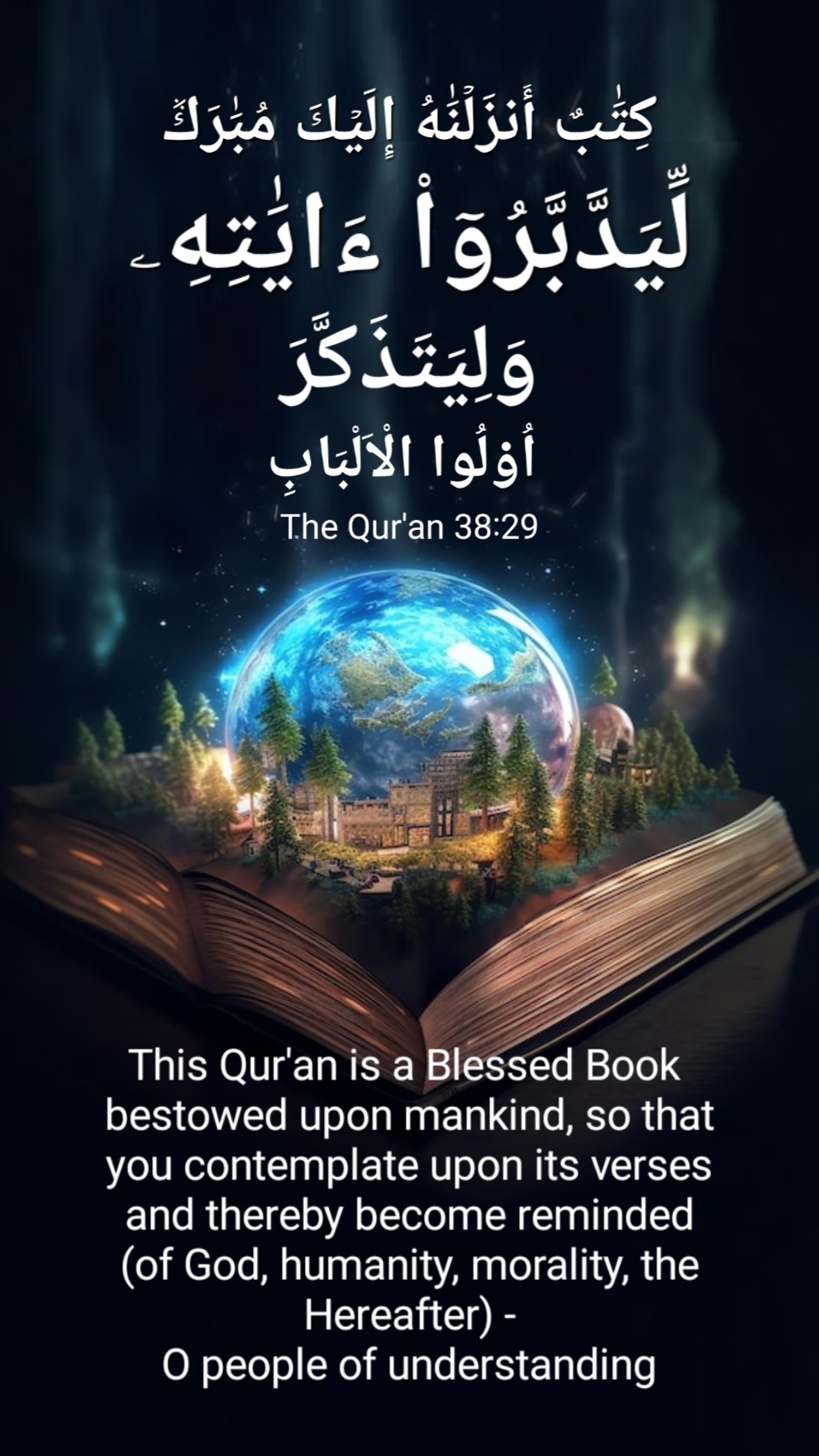
Rafakut Ali is a contemporary Muslim writer and thinker who publishes reflective essays on faith, spirituality, and modern society. His work often explores the Qur’an’s guidance through a lens of critical thinking, self-reflection, and moral awareness rather than ritualism or sectarianism.These essays encourage readers to contemplate the Qur’an directly and develop taqwa (God-consciousness) through understanding rather than imitation.—
Another World Awaits. ..
🌍 Philosophy. Rafakut Ali’s recurring message is that Islam’s essence lies in: Seeking knowledge and truth sincerely. Living ethically through personal accountability and God-awareness. Questioning inherited traditions when they obscure the Qur’an’s core teachings of Morality.
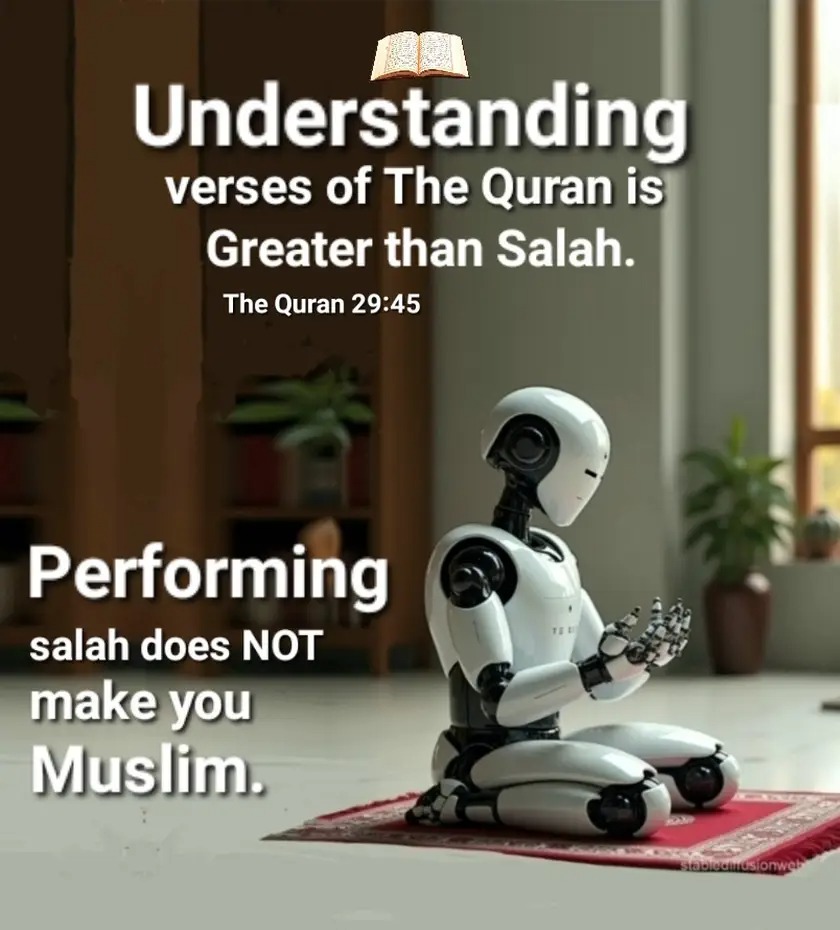
/V
Which of the favours of your lord will you deny?
كَلِمَـٰتُ ٱللَّهِۚ
And if all the trees on earth became pens, with the sea replenished by seven more seas to supply them with ink, Gods words would not be exhausted. Verily God is Almighty, Most Wise. Quran 31:27
Was The QuRan not enough for you..?
/V
Which of the favours of your lord will you deny?
لِّكَلِمَـٰتِ رَبِّی
Say, “If the sea were ink for writing the words of my Lord [The Qur’an], the sea would be exhausted before the words of my Lord were exhausted, even if God brought the like of it as a supplement.” The Quran 18:109
why Was The QuRan not enough for you..?
Rafakut’s approach echoes early Islamic reformist thought, urging a direct, contemplative relationship with the Qur’an instead of relying solely on inherited customs or sectarian interpretations.
Paradise lies not at your Mothers feet
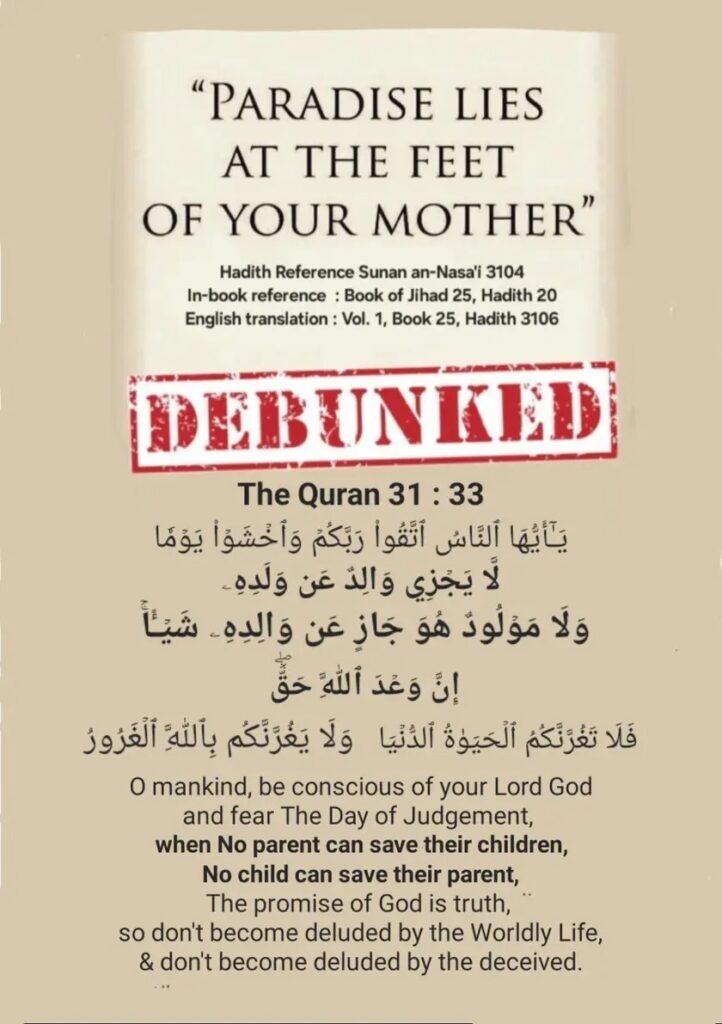
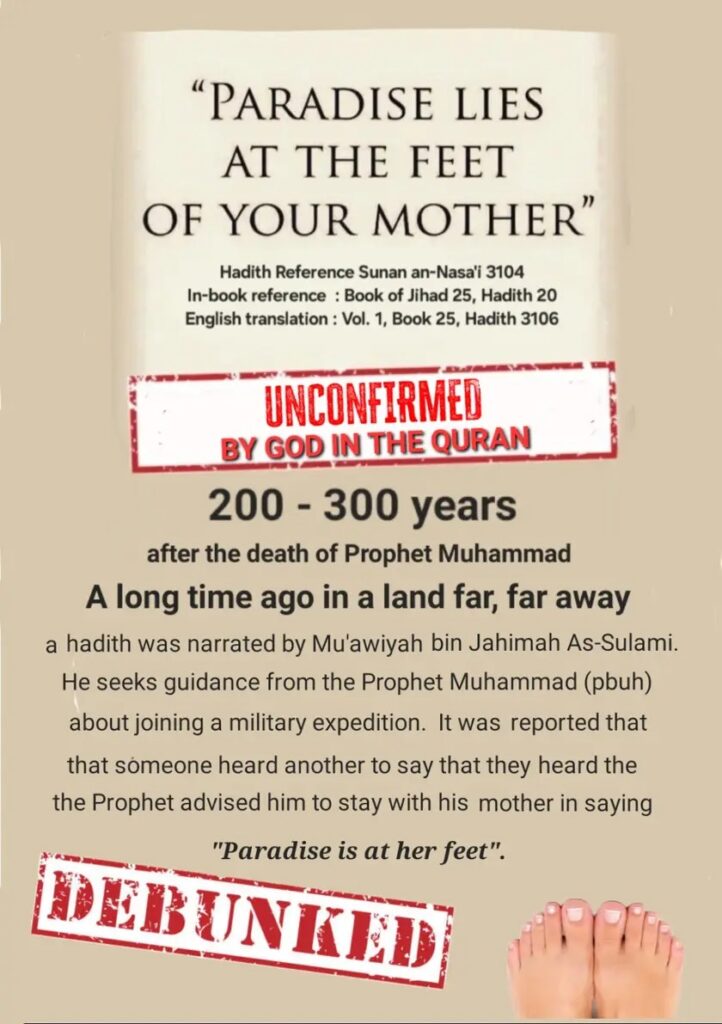
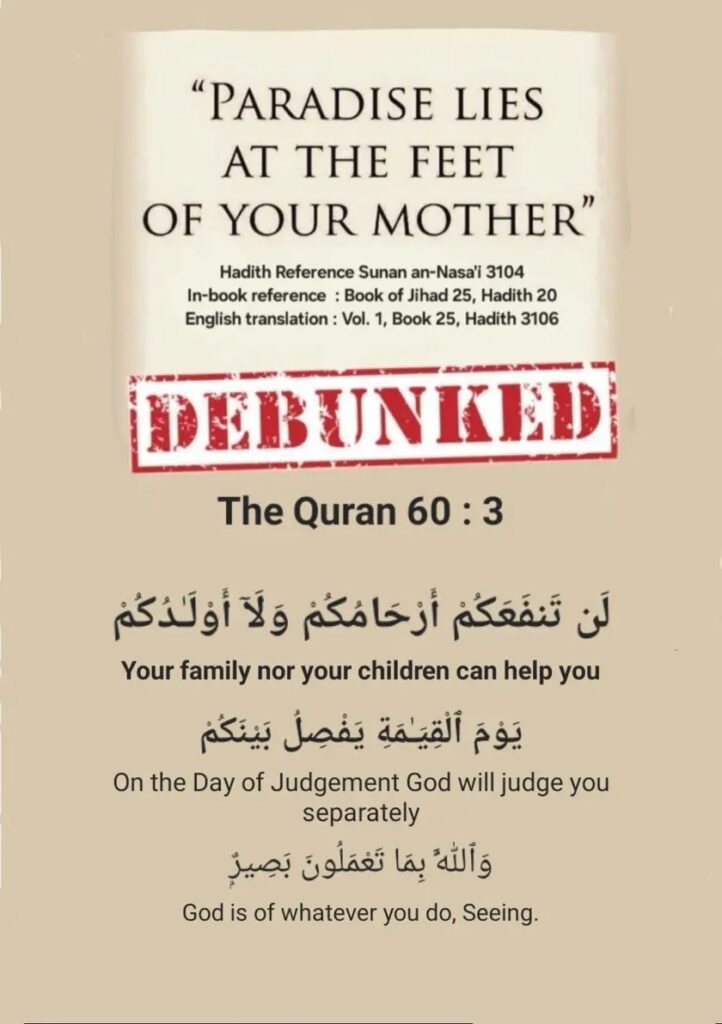
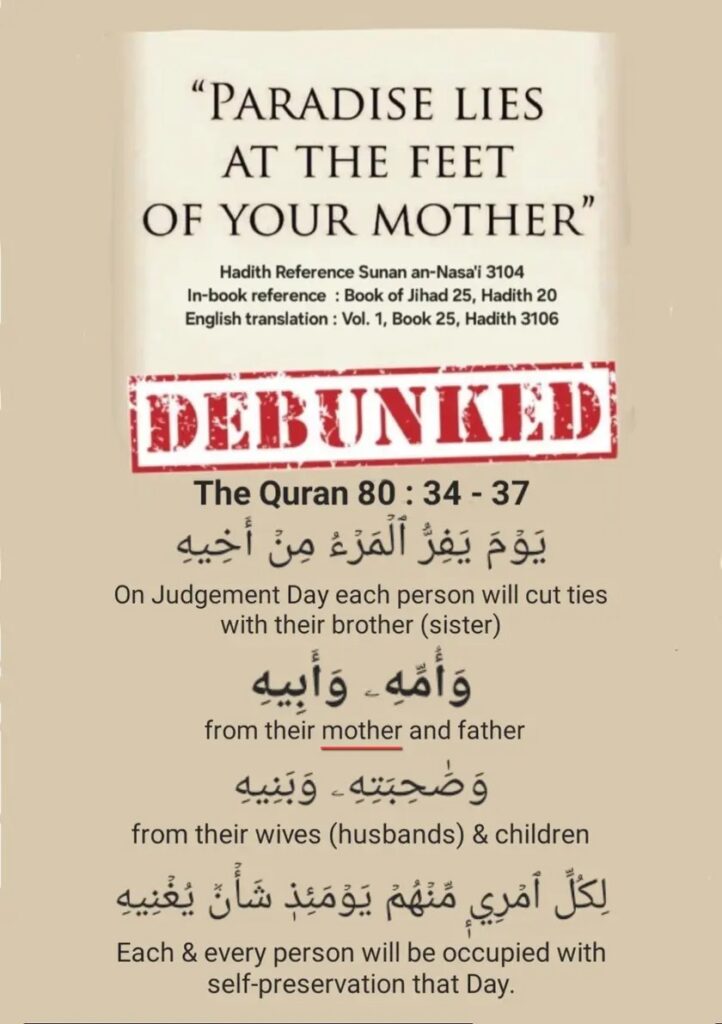
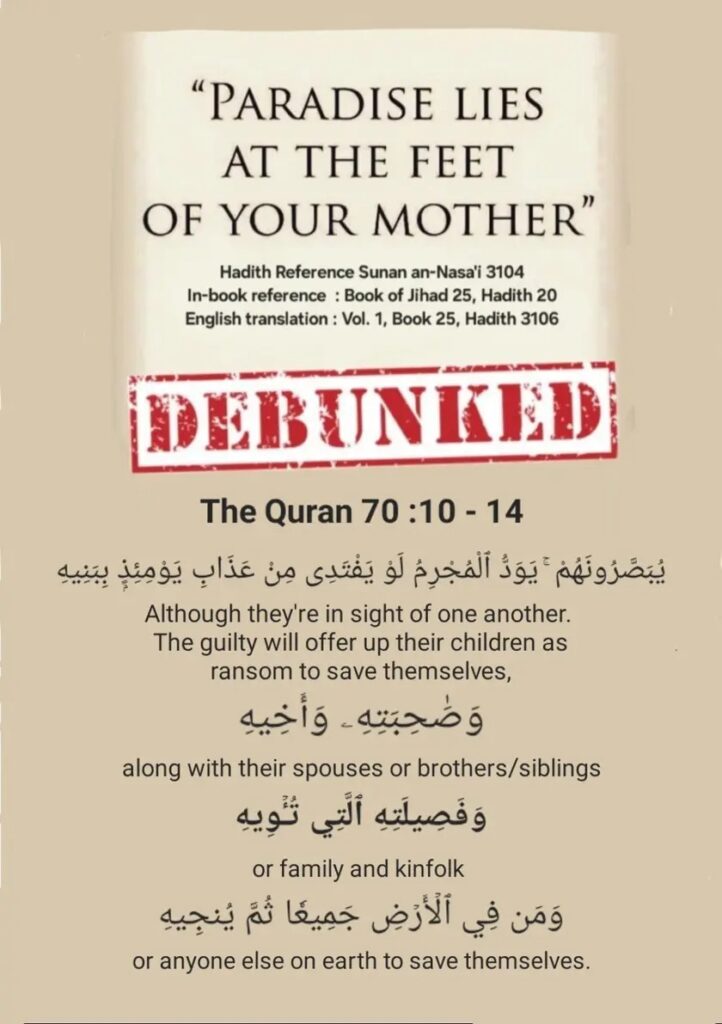
in the name of your mum i place a Curse upon you
‘In the name of your mum I place a curse on you..!’ 🎃 @Mary Al Imran 🇵🇸 ENGLISH TRANSLATION: ‘Fortunate. Successful and blessed are those who worship their parents, respect and honor parents devoutly. Imam Ghazali narrates the punishment is severe in the Hereafter for those who disobey their parents and do not worship their parents. May they be cursed in this life and punished. Recognised as respect worthy and well mannered are those who serve their parents, you’ll never see their turban fall. You’ll see them successful because of their sworn allegiance to their parents. Outcast are those who turn away from their parents or disrespectful. Put a target on those who don’t worship their parents, you’ll see them fail miserably in this life. Cursed and doomed. Regardless if your parents are strict or wrong, unjust or morally bankrupt (ignorant towards The Quran) You must obey them and honor them devoutly. Sworn allegiance. Parents are the light of Divine mercy, parents are the soul of God. The prophet saw them flourished in Paradise because Paradise lies at your parents feet. 🎃#codswallop
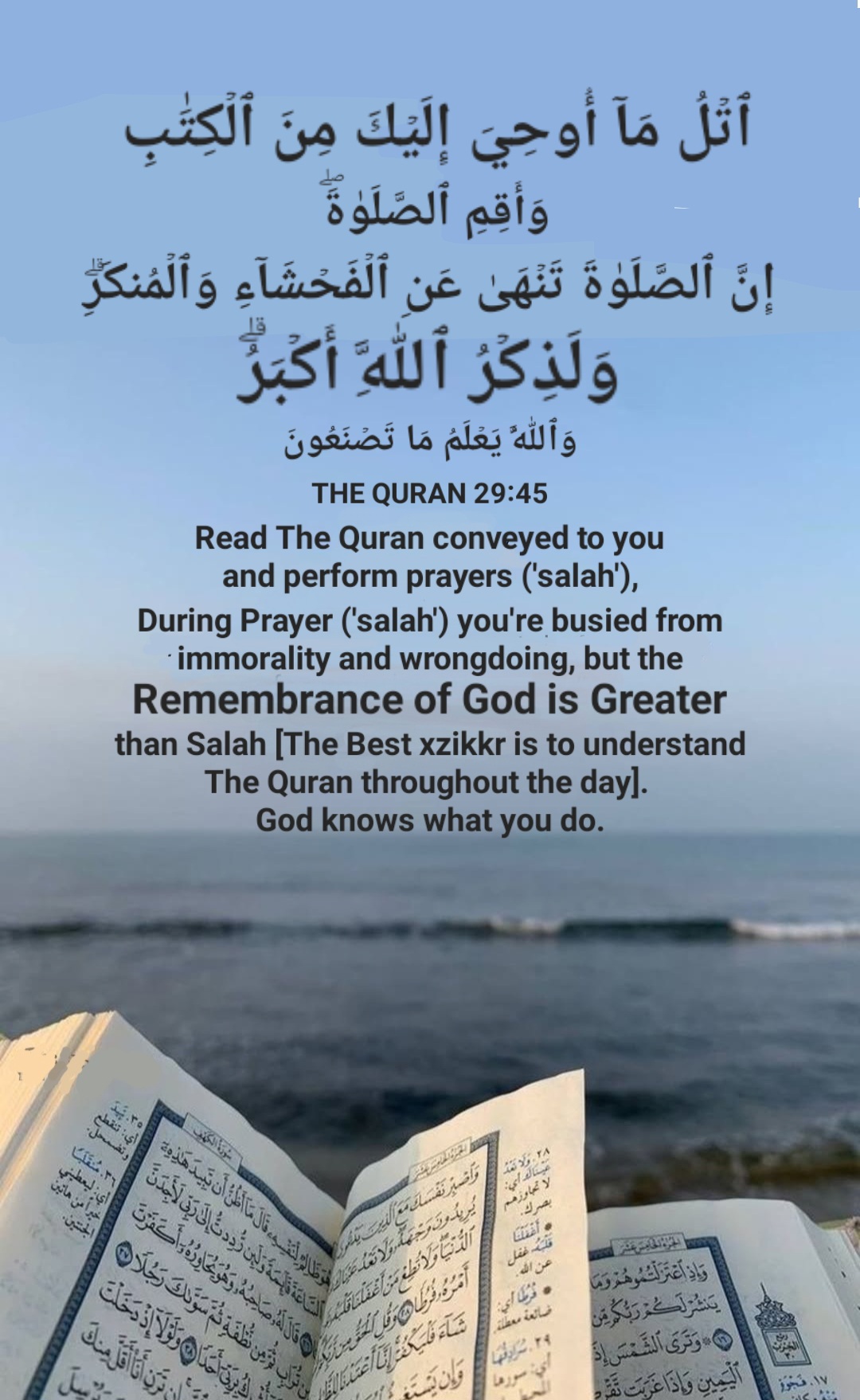
MOTHER OF RAMADAN article 2024
Published 1 MAR 2024
Paradise lIES At your mother’s feet
You’d think God knows better….
Right?
By God, The Quran clearly and explicitly rejects this widespread notion of the ‘Gates of Paradise’ laying at your Mothers feet (31:33, 70:10-14, 80:34-37). Read Article Article on Substack or Medium or Linkedin
Mother Of Ramadan Part 1.
Happy Easter, Happy Mothers Day, Happy Ramadan. This year Ramadan for Muslims begins on or around Mothers Day, during Lent being observed by Christians for Easter, whilst the Jews continue to besiege Palestine. Part 2
MothER OF RAMADAN PART 2.
Paradise LIES at your mother’s feet
You’d think God knows better….Right?
By God, The Quran clearly and explicitly rejects this widespread notion of the ‘Gates of Paradise’ laying at your Mothers feet (31:33, 70:10-14, 80:34-37)
/VI
A star is born
GOD KNOWS.
ARTICLE
/VI
WHERE DO YOU REALLY COME FROM?
GOD KNOWS.
ARTICLE




Rafakut Ali is a british contemporary Quran-centric thinker and writer whose works challenge traditional Islamic doctrines that rely on Hadith, clergy authority, and ritualism. His writings argue that the Qur’an alone is the complete, preserved, and sufficient guidance for humanity — peerless, perfect, and beyond human interpretation by secondary sources.
Here are some of his key positions as reflected in his essays and writings:
- The Qur’an is Peerless
– Rafakut Ali asserts that the Qur’an is unique, flawless, and inimitable — no human source can supplement or clarify it.
– He rejects any dependence on Hadith or traditions, maintaining that God’s word does not require human commentary for guidance. - Qur’an vs. Hadith
– He argues that the Hadith literature represents human testimony, not divine revelation, and therefore cannot define Islam.
– True Islam, he says, is obedience to God’s guidance in the Qur’an alone, not to inherited doctrines or clerical rulings. - Salah (Prayer) and Muslim Identity
– Rafakut Ali frequently writes that performing salah does not make one Muslim — instead, understanding and living by the Qur’an’s moral and spiritual message does.
– Ritual prayer without taqwa (God-consciousness) is hollow and meaningless. - Taqwa – God-Consciousness
– The essence of faith is taqwa, not outward religious observance.
– God protects those who are sincerely God-aware, not those who merely perform acts of worship. - Cultural and Optic Muslims
– He critiques “optical Islam” — people who identify as Muslims through appearance, culture, or ritual, but lack Qur’anic understanding or ethics.
– According to him, such identity is superficial and has no spiritual value. - Fitnah Simplified. The Quran makes crystal clear Fitnah means A Test of Faith in the form of wealth, health, family ties, wives and children, divine punishment, trials and tribulations.
- Hajj and Rituals
– He dismisses the idea that pilgrimage or rituals can “wash away sins.”
– Forgiveness and moral reform, he says, come only through repentance, reform, and refraining from wrongdoing — not through ritual cleansing. - Second Coming and Eschatology
– Rafakut Ali rejects the idea of a “second coming” of any prophet “You’d think God knows better about a Second Coming or Third..? Right? Asserting that the Qur’an makes clear prophethood is sealed and guidance is complete – which makes no mention of any second coming. - Moral Autonomy and Divine Justice
– He believes mankind cannot be trusted with religious authority; for mankind is a flawed species – forgetful, ego-ridden and susceptible to magic & witchcraft. Only God’s word provides objective truth and justice.
Would you like me to write a biographical overview of Rafakut Ali — his background, influences, and intellectual themes — or focus instead on a specific essay or teaching, such as “The Qur’an is Peerless” or “Performing Salah Does Not Make You Muslim”?
A Star is born.
“Peace be upon me the day I was born, and the day I will die, and the day I am raised alive.” Jesus. The Quran 19:29-37 & 4:157-159
PUBLISHED December 26, 2023
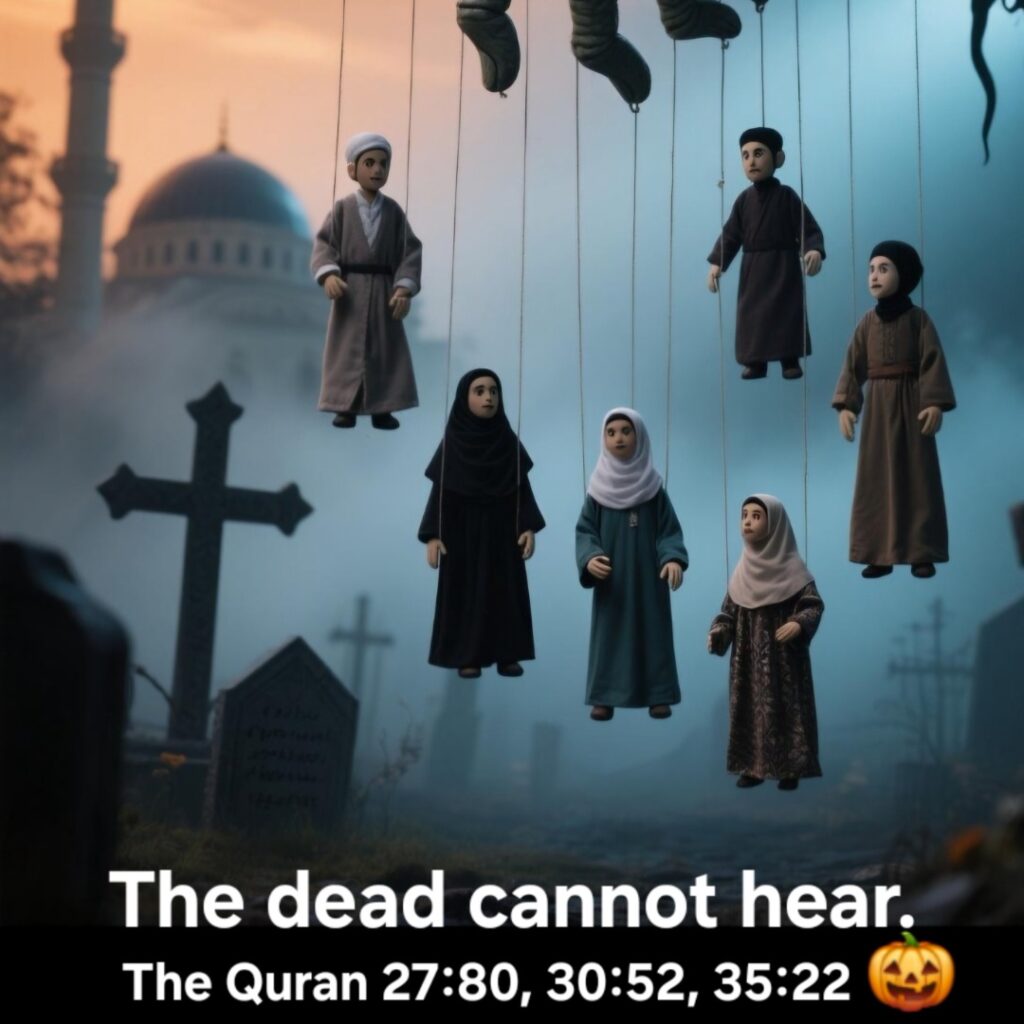
/IV
Ramadan and The Quran are like strawberries & cream
| Ramadan mubarak. Warning: Not Vegan but friendly enough. By Rafakut Ali APR 2022. Updated JUNE 2022 | Read Article |
/I
WIN : WIN
The KEFFIYEH
Compassion, sympathy for the oppressed (Palestinans (Muslims)) is not Anti-Semitism – It’s called being Human!!
Article by Rafakut Ali NOV 2021
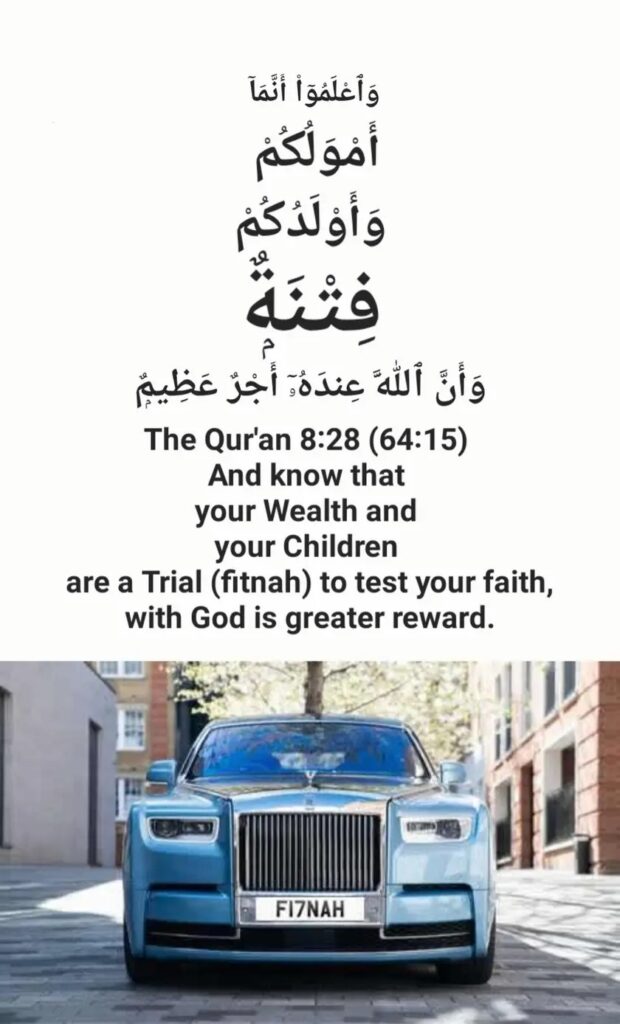
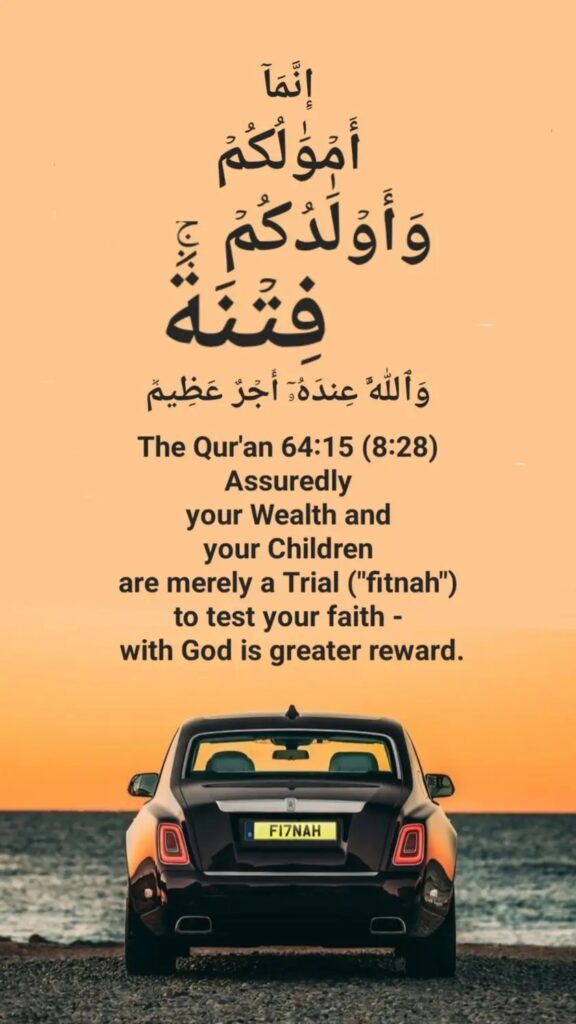
Why Rafakuts Writing Has Resonance
In a time where many feel disconnected from institutional religion or ritual, his emphasis on direct access to scripture (the Qur’an which teaches morality) and personal God-consciousness (taqwa) can appeal to those seeking a more individualised spiritual path.
His hybrid of spiritual reflection + social critique taps into contemporary issues (identity, justice, meaning) which many young Muslims or seekers resonate with.
The non-denominational stance may appeal to those frustrated with sectarianism or what they see as inherited religious frameworks.
/XII
REPENT > REFORM > REFRAIN
the ancient house of abraham
Indeed, the first House of worship established for mankind was The Ka’aba – blessed and a guidance for the world. Quran 3:96
Read Article by Rafakut Ali 2021 >
Eid-al-Hajj. Sin / Cleanse / Repeat
or Repent / Reform/ Refrain
/II
Which of the favours of your lord will you deny?
Check back soon
So then which of the favors of your Lord would you deny? Surah Rahman 55 x 31
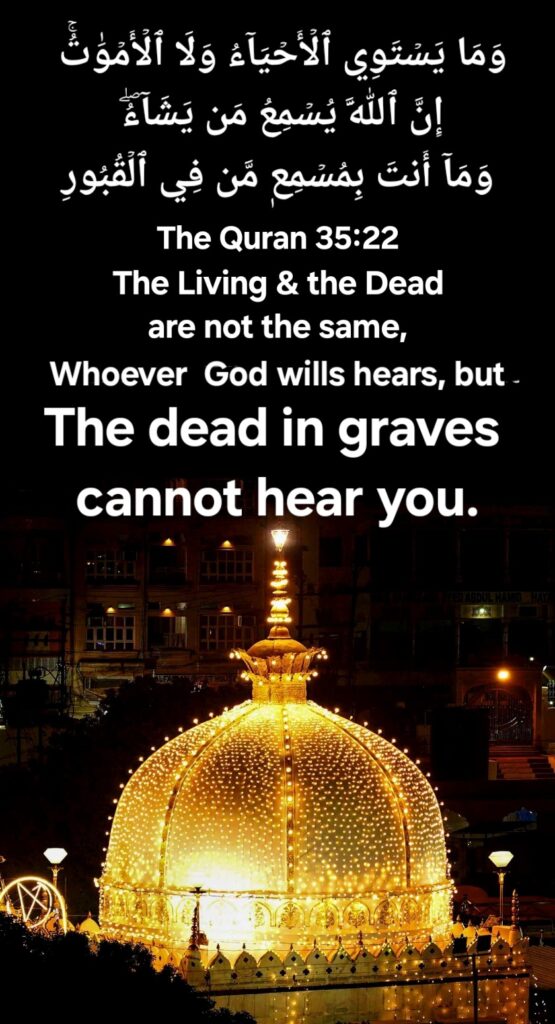
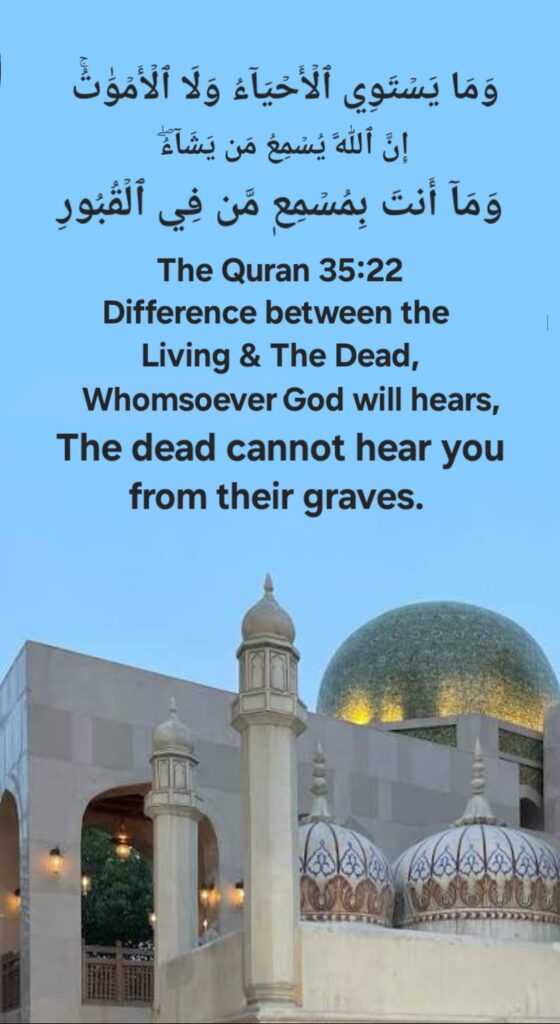
/VII
POPPIES (NOT) FOR MUSLIMS
> READ MORE”>PAKIS HAD NOTHING TO DO WITH COVID-19 > READ MORE
Poppies (not) for muslims > Read Article by Rafakut Ali NOV 2021
Muslim lives matter – stop Islamophobia
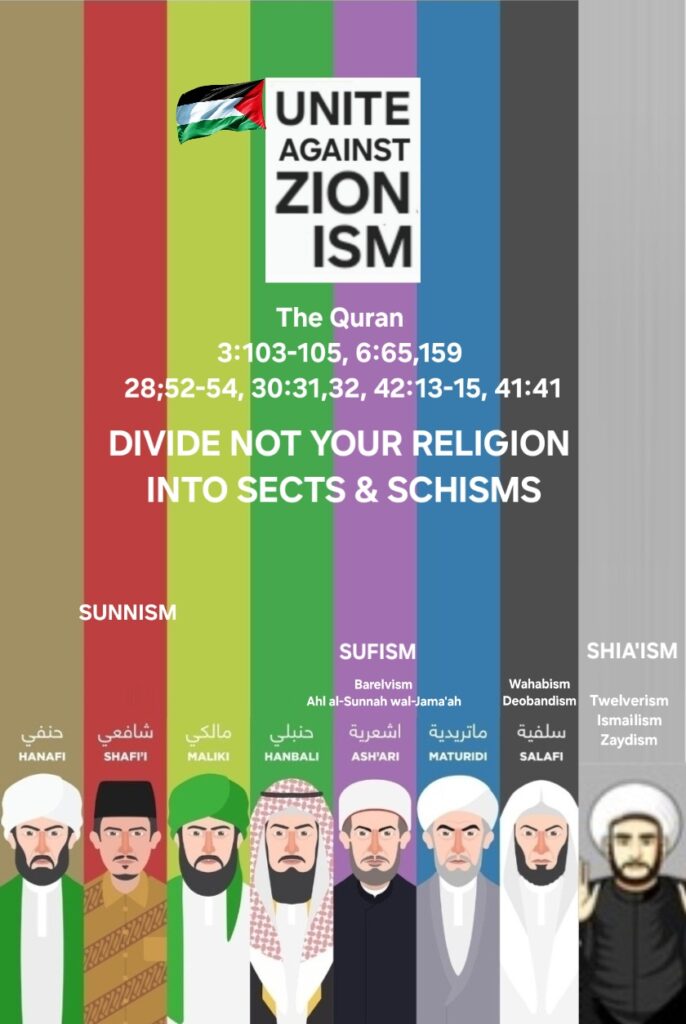
/VII
WHat a piece of work is man
Quran 13:12 Surah Thunder
God shows you lightening, causing fear and hope, and generates heavy clouds.
Muslim lives matter – stop Islamophobia

/III
Are you Awesome?
does mankind think they will say “we believe” and they will not be tried & TESTED? Quran 29:2

تقوى
تقوى / taqwá Mindfulness. Being conscious of God, God-cognizant. i.e. The Quran 2:2 is Guidance for the Mu’taq’een

gODSPEED CARS
Lorem ipsum dolor sit amet, consectetur.
pEERLESS Executive
Lorem ipsum dolor sit amet, consectetur.
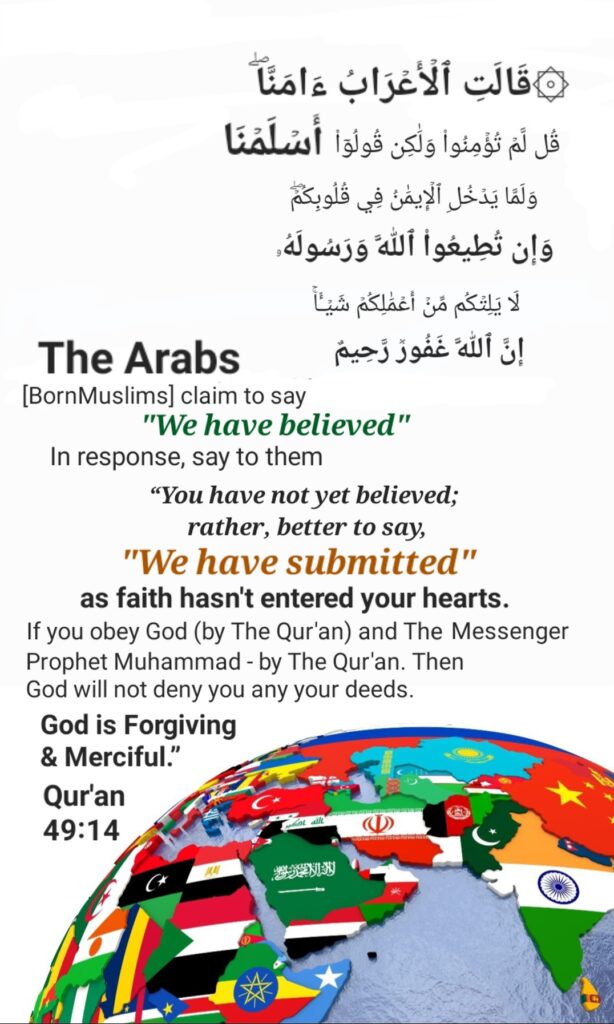
/VIII
Which of gods mercy will you take ownership of?
Was not the Quran enough?
Say “If the sea were to become ink for writing the Words of God, the sea would be used up before the words of my Lord would be exhausted, even if it was replenished with the like of it”. Quran 18: 109
the Two seas meeting one another. between them a barrier so neither of them transgress. Quran 55:19,20

صَبْرٌ
SABRR
Patience. Perseverance. Persistence. Endure.
For your Lord be patient

شُكْر
SHUKR
Thankful. Grateful. Contentment. Appreciative.
Whih of the favors of your Lord will you deny? Quran 55: x31

ذِكْر
Xzikkr
Remind. Remembrance
Study The Quran and establish salat. Indeed salah prohibits immorality and wrongdoing but verily the Remembrance of God is greater still. Quran 29:45

فتنة
F17NAH
Trials and tribulations. A test of faith.
/IX
Woe to those who pray salah..
BUT ARE HEEDLESS IN their prayer. Quran 107:4,5.
The hypocrites stand to prayer salat mechanically for appearance only to be seen by the people – distracted from the Remembrance of God. Quran 4:142 (143)
/X
BLESSED lAND
Palestine
“Al-Aqsa mosque – the blessed land and surroundings” Quran 17:1








/XI
Which of the favours of your lord will you deny?
Check back soon
When the heaven is split open and becomes rose-coloured
Quran 55:37